






jasonhardware@foxmail.com+86-0574-58202256
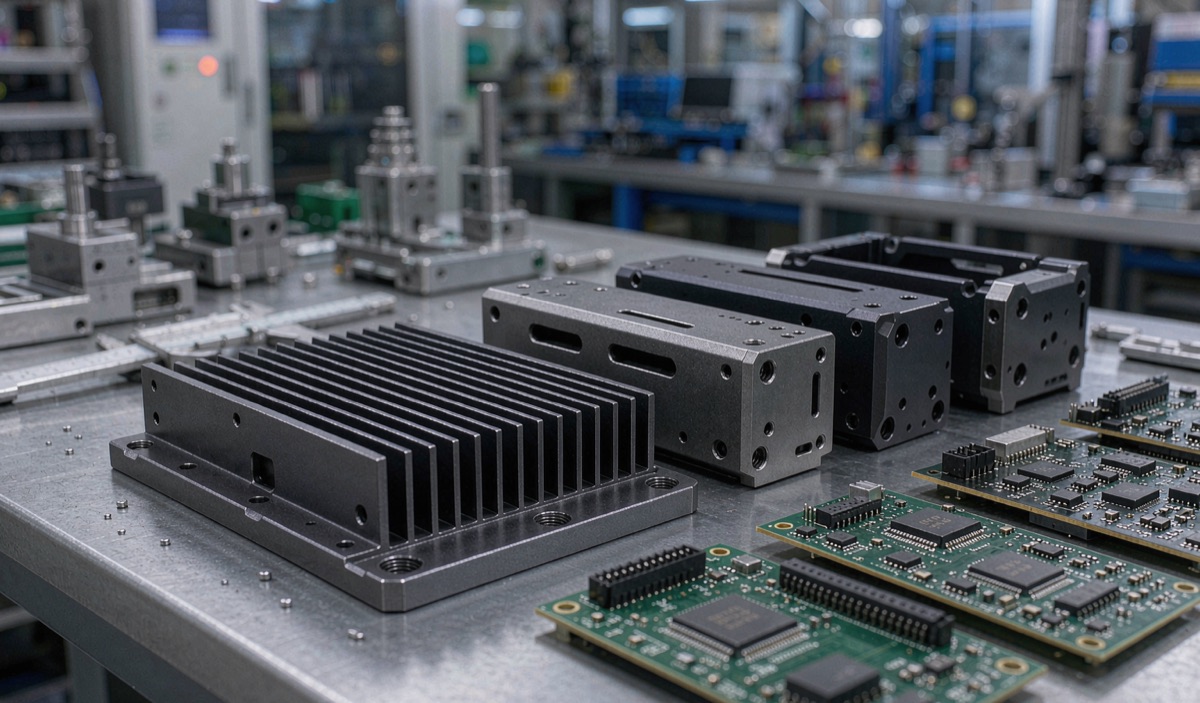
Every electronic product hides a surprising amount of machined metal inside it: the heat sink that keeps a server chip alive, the aluminium enclosure that shields a measurement device, the connector housings that survive ten thousand mating cycles. As devices shrink and power densities rise, electronics companies increasingly depend on precision CNC machining for both prototypes and production.
Renjiu Machinery machined components are found in server hardware, industrial controls, audio equipment and telecom devices. This guide covers the specifics electronics buyers care about most: thermal parts, enclosures, finishes and speed.
| Category | Example Parts | Typical Material | Key Consideration |
|---|---|---|---|
| Thermal management | Heat sinks, vapor chamber plates, cold plates | Aluminum 6063/6061, copper C1100 | Flatness ≤0.05 mm, fin accuracy |
| Enclosures & chassis | Instrument cases, rack panels, shield boxes | Aluminum 5052/6061 | Cosmetic anodizing, EMI shielding |
| Connectors & RF | RF housings, waveguide parts, contacts bodies | Brass, aluminum, PTFE-filled | Tight coaxial tolerances |
| Structures | Mounting brackets, guide rails, arms | Aluminum, stainless | Rigidity, weight |
| Optics & sensors | Lens barrels, sensor mounts | Aluminum 6061, black anodized | Thread precision, reflectivity |
A cold plate or heat sink face that is not flat creates an air gap, and air is a terrible thermal conductor. For server and power electronics cooling plates we routinely hold:
Copper cold plates for EV and laser applications are a growing share of our work — copper machines differently from aluminum (gummy chips, tool wear) and needs its own process window. See our materials guide for alloy options.
Electronics enclosures are seen and touched. That shifts the requirements:
Natural or black anodize with consistent colour batch-to-batch. Our anodizing vs powder coating guide explains why anodizing dominates electronics housings: thin film, dimensional stability, premium feel.
Clean threads after anodizing (plugs or re-tapping), masked grounding areas where conductivity is needed, laser-engraved part numbers instead of ink that wears off.
Conductive gasket grooves and shield cavities machined in the same setup as cosmetic surfaces keep alignment perfect and cost low.
For aluminum tolerance economics in detail, read our aluminum tolerances guide.
Electronics development runs on sprint cycles that traditional machining shops can't match. Renjiu's response model:
When a device ramps, machined parts often face a make-or-buy decision: keep machining, or move to die casting or injection molding. We help customers make that transition honestly — and often run the machined first articles, the casting tool pilots and the machining fixtures, because hybrid strategies (casting blank + machined critical faces) are usually the real answer.
Most heat sink cost is decided in CAD, not at the machine. Design notes that cut cost without cutting performance:
Straight fins with uniform thickness and ≥1.5 mm gaps machine fast. Tapered and curved fins need 4-axis time. If your thermal simulation says straight fins hit the target, resist the designer's urge to sculpt.
Specify flatness only on the component footprint area, not the whole base. A 200 mm base at ≤0.05 mm overall costs more than the same flatness on a 60 mm pad.
Integrated standoffs and captured-thread bosses remove a whole assembly step — and they machine in the same setup when designed with tool access in mind.
Machining wins below fin aspect ratios of ~10:1 and for structural bases; above that we'll tell you a skived or bonded-fin part from our partners performs better — honesty about process boundaries is part of the service.
Yes — we batch treatment lots and retain reference coupons per customer. Colour drift is a batch-management problem, not an anodizing mystery.
Routinely. Copper needs its own speeds/feeds and tooling; we also braze and solder plate assemblies with leak testing.
Laser engraving handles 0.3 mm characters and logos with consistent depth — machined engraving below 0.5 mm gets fragile.
Yes, installation is done post-anodizing with documented torque specs, or we machine direct threads with thread-locking insert coils where higher strength is needed.
Grooves for conductive gaskets are machined to ±0.05 mm with surface finish controlled for gasket seating — a common request from telecom and instrumentation customers.
Send your 2D/3D files and get a detailed quotation within 24 hours — DFM feedback, material and tolerance advice, and lead time included. Prototypes from 1 piece, no minimum order.
Request a Free Quote → WhatsApp Us
Or email jasonhardware@foxmail.com · Reply within 24 hours, Monday–Saturday
Contact: Mr Zhang
Phone: +86-18368240367
E-mail: jasonhardware@foxmail.com
Add: No.16 Laoshan Road, Beilun District, Ningbo City
LiveChatclose
 Send Email
 WhatsApp