






jasonhardware@foxmail.com+86-0574-58202256
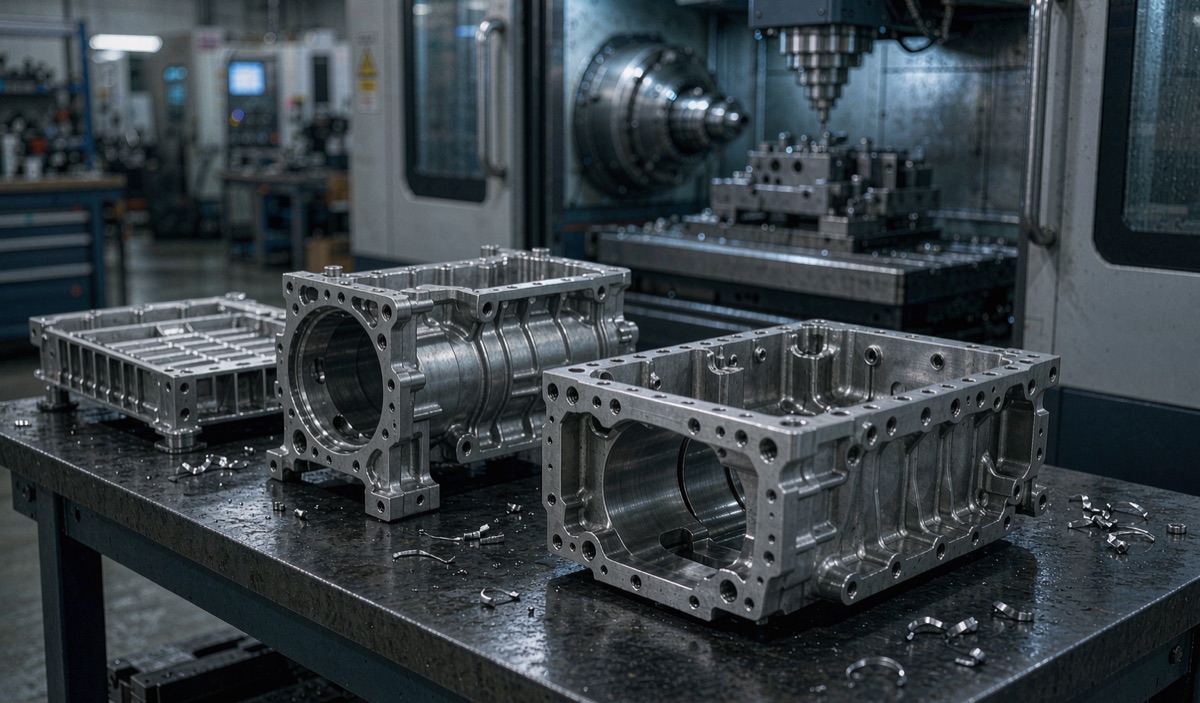
The automotive industry runs on precision. A passenger car contains roughly 30,000 parts, and an increasing share of them — engine components, gearbox housings, EV battery structures, brake components, sensor bodies — are produced by CNC machining. For a Tier-2/Tier-3 supplier, choosing the right machining partner directly affects assembly line efficiency, warranty costs and your ability to win new platforms.
At Renjiu Machinery, we have supplied CNC machined automotive parts to customers in Europe, North America and Asia for more than a decade. This guide summarises what automotive buyers should look for: typical parts, material choices, tolerance expectations and quality documentation.
| Category | Example Parts | Common Materials | Key Requirement |
|---|---|---|---|
| Powertrain | Engine housings, cylinder heads, gearbox shafts | Aluminum A356/6061, 42CrMo4 | Sealing surface flatness, fatigue strength |
| New Energy Vehicle (NEV) | Battery cooling plates, motor housings, inverter housings | Aluminum 6061/6082, copper | Hermetic sealing, thermal flatness (≤0.05 mm) |
| Chassis & Braking | Caliper bodies, knuckles, steering components | Ductile iron, forged aluminum | Crack detection, traceability |
| Fuel / Fluid Systems | Valve bodies, fittings, pump housings | Brass, stainless steel 303/316 | Leak-proof threads, cleanliness |
| Interior & Sensor | Sensor housings, connector bodies, custom brackets | Aluminum, POM, PEEK | Cosmetic finish, dimension stability |
Aluminum remains the dominant automotive machining material thanks to its weight, corrosion resistance and machinability. 6061-T6 is the workhorse for brackets and housings; die-cast A356 blanks finished by machining are common for engine and motor housings. For high-strength applications, case-hardening steels such as 42CrMo4 (4140) with quenching and tempering are preferred.
Our materials overview covers the full range we stock, including stainless steels, brass, copper and engineering plastics for fluid and interior systems.
Standard CNC milling and turning on aluminum easily holds ±0.05 mm; precision operations reach ±0.01 mm. But tighter is not better — every unnecessary decimal adds cost. A practical rule for automotive drawings:
For a deeper explanation of ISO 2768 grades and cost impact, see our guide to CNC machining aluminum tolerances.
Automotive projects rarely stop at "parts pass". Buyers should clarify the documentation package early:
Our quality control process is built around 100% first-article inspection and batch sampling with CMM reports for every shipment.
Automotive development cycles compress every year. The typical Renjiu workflow for an automotive customer:
CNC machined prototypes in final material, so test results are valid for the series design.
We flag features that drive cost: deep pockets, thin walls, tight radii, unnecessary tight tolerances. A 30-minute DFM review often saves 15–25% of unit cost.
Dedicated fixtures, SPC on key characteristics, and surface finishing under one roof — anodizing, chrome plating, powder coating and passivation.
Understanding the cost structure helps buyers negotiate intelligently instead of just pushing for a lower number:
A dedicated fixture and proven process sheet might take 4–8 hours to build once — then every repeat batch runs fast. This is why unit price drops sharply between 100 pcs and 1,000 pcs, then flattens. Ask suppliers to quote at several volume breaks to see the real curve.
Each extra decimal place roughly multiplies the cost of the affected feature: ±0.1 mm is free-ish, ±0.02 mm needs careful tooling and measurement, ±0.005 mm may need grinding. Only functional surfaces deserve the tight numbers.
Machining from solid bar wastes up to 70% of material as chips on housings. Where volumes justify it, near-net-shape castings with machined critical faces cut both material cost and machining hours — a conversation worth having at design stage, not after prices hurt.
Anodizing and plating add lead time and minimum-batch charges. Batching treatment lots across orders (with proper traceability) reduces both.
We operate PPAP-style documentation (PSW, dimensional results, material certs) and welcome customer audits. Many Tier-2 buyers run our parts through their own IATF framework using our reports.
Yes — common aluminum grades (6061, 6082, A356 castings), 42CrMo4 and stainless grades are stocked; specialty grades are sourced with mill certificates within days.
STEP/IGES 3D models plus PDF/DWG 2D drawings with GD&T. 3D-only orders are accepted for prototypes, but series production needs the 2D for critical characteristics.
Custom returnable or disposable packaging with per-part separators is available; label content (part number, quantity, batch, barcode format) follows your specification.
Standard automotive-scale parts: 5–10 working days. Complex housings with multiple treatments: 2–3 weeks. Emergency slots exist for line-down situations — call us.
Send your 2D/3D files and get a detailed quotation within 24 hours — DFM feedback, material and tolerance advice, and lead time included. Prototypes from 1 piece, no minimum order.
Request a Free Quote → WhatsApp Us
Or email jasonhardware@foxmail.com · Reply within 24 hours, Monday–Saturday
Contact: Mr Zhang
Phone: +86-18368240367
E-mail: jasonhardware@foxmail.com
Add: No.16 Laoshan Road, Beilun District, Ningbo City
LiveChatclose
 Send Email
 WhatsApp