






jasonhardware@foxmail.com+86-0574-58202256
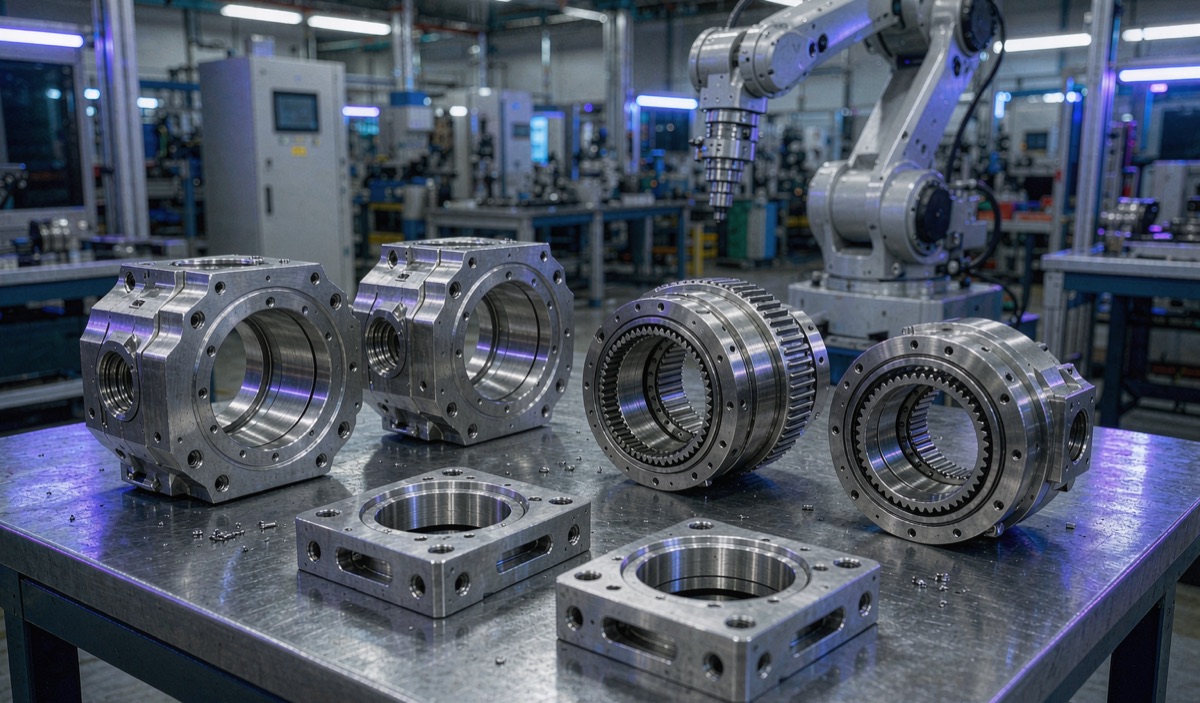
Robotics is a precision game on both sides of the machine: the robot itself is a stack of machined components — joint housings, reducer parts, arm segments — and the workcells robots serve are built on machined fixtures and frames. Whether you build six-axis arms, SCARA units, cobots or AMR platforms, your performance ceiling is set by machining quality.
Renjiu Machinery supplies CNC machined parts to robotics and automation OEMs. This article breaks down the parts, tolerances and materials that matter most in robot construction.
| Subsystem | Machined Components | Materials | Critical Requirement |
|---|---|---|---|
| Joints (J1–J6) | Housings, output flanges, covers | Aluminum A356 cast + machined, 6061 | Concentricity, bearing seats ±0.01 mm |
| Reducers | Harmonic drive components, RV gear blanks | Alloy steel 20CrMnTi, 42CrMo4 | Heat treatment, gear quality |
| Arm structure | Link segments, wrist bodies | Aluminum 6061/7075 | Stiffness-to-weight, symmetry |
| End effectors | Gripper bodies, tool changers, brackets | Aluminum 7075, stainless | Repeatability ±0.02 mm |
| Mobile robots | Wheel hubs, suspension arms, LIDAR mounts | Aluminum, POM gears | Light weight, damping |
A robot joint is a chain of tolerances: motor flange, reducer input, output bearing, arm interface. Any eccentricity compounds along the arm and shows up as lost accuracy at the tool centre point. Key machining disciplines:
Held at ±0.01 mm with measured surface finish — ground or fine-bored, never just end-milled and hoped for.
Both sides of a joint housing machined in one setup on a 4th/5th axis or a double-sided process, so the two bearing bores stay aligned without measurement tricks.
Most arm housings start as die castings or sand castings; only mating faces, bores and threads are machined. Controlling casting porosity before machining avoids scrapped housings at final leak and load tests.
Aluminum carries the structure; steel carries the torque.
Our materials overview lists stock alloys and treatment options. Post-treatment machining of hardened parts requires grinding capability — check that any supplier offering gear blanks also controls the hardening distortion.
If you are new to specifying aluminum tolerances, our practical tolerance guide explains the cost curve.
Inside a robot, finishing is functional, not cosmetic:
Robot OEMs and integrators share one pain: demand spikes. A machining partner must scale without re-qualifying parts. Renjiu's approach:
The robotics industry's classic mistake: qualifying a prototype shop, then requalifying a volume shop — and discovering the robot's behaviour changed because a housing was machined differently. Renjiu's model avoids the handover:
Robots fail at the joints where cables flex, not in the arm structure. Machined details that extend service life:
These features never appear in brochures but decide warranty economics. They also demonstrate why machining and design feedback must be linked — which is what our DFM process does (see our service model).
Yes — customer-supplied or our own castings both work. For our castings, we control the die casting blank quality (porosity classes) so machining rejects stay low.
That's a robot kinematics question, but machining sets the ceiling: joint concentricity and bearing seat quality at our levels support repeatability figures down to ±0.02 mm on compact arms.
Yes: carburised 20CrMnTi blanks with post-hardness grinding on critical profiles, hardness and metallurgical reports included.
Anodize thickness and surface finish specifications for cleanroom compatibility (particle shedding) are supported with per-batch coupons.
From 5-piece engineering builds to 2,000+/month per part number, with reserved capacity for repeat customers.
Send your 2D/3D files and get a detailed quotation within 24 hours — DFM feedback, material and tolerance advice, and lead time included. Prototypes from 1 piece, no minimum order.
Request a Free Quote → WhatsApp Us
Or email jasonhardware@foxmail.com · Reply within 24 hours, Monday–Saturday
Contact: Mr Zhang
Phone: +86-18368240367
E-mail: jasonhardware@foxmail.com
Add: No.16 Laoshan Road, Beilun District, Ningbo City
LiveChatclose
 Send Email
 WhatsApp