






jasonhardware@foxmail.com+86-0574-58202256
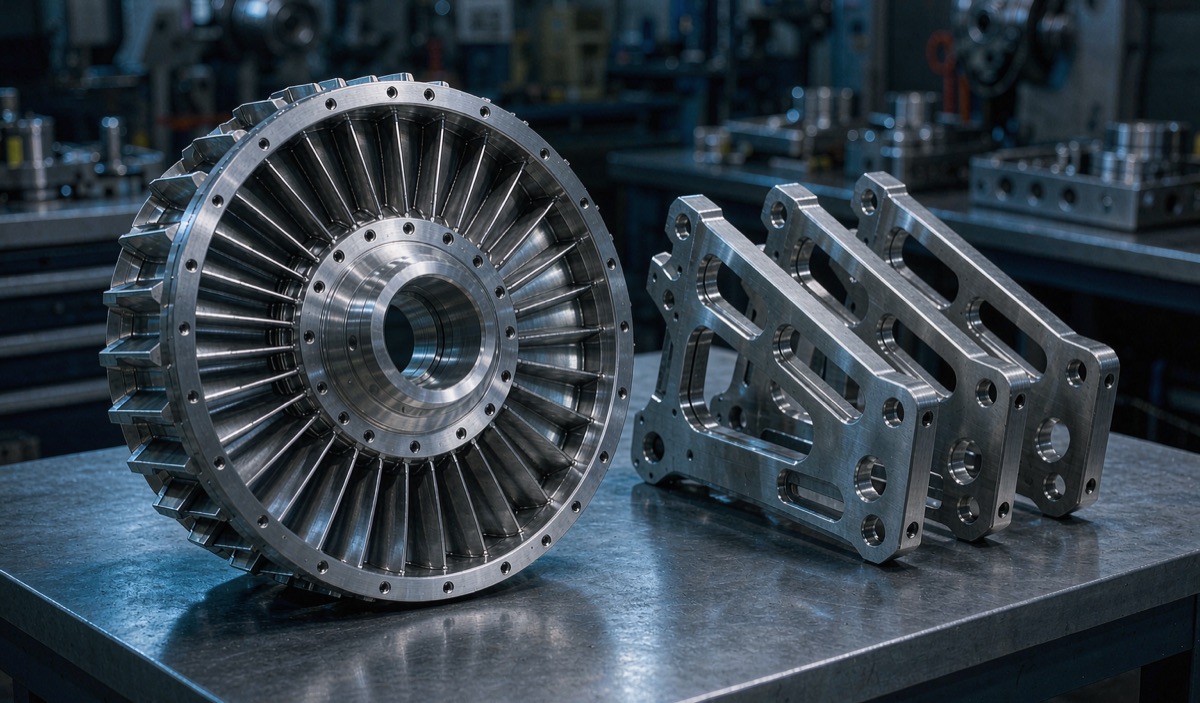
Few industries punish manufacturing errors like aerospace. A bracket that fails in service can ground an aircraft; a out-of-tolerance fitting can delay certification by months. That is why aerospace buyers audit their machining partners relentlessly — and why CNC machining, with its repeatability and full traceability, is the backbone of aerospace structural and engine component production.
Renjiu Machinery manufactures CNC machined components for aerospace-tier customers and industrial aviation programmes. This article explains what the industry expects from a machining supplier, and how to qualify one.
Aerospace parts split into two big families: engine (hot section, compressor, turbine) and airframe (structural, actuation, interiors). CNC machining touches both:
The aerospace favourite for strength-to-weight and corrosion resistance — and notoriously hard to machine. Rigid setups, low cutting speeds and sharp tooling are mandatory. Renjiu machines titanium brackets and fittings with controlled thermal management to preserve fatigue life.
Airframe workhorse alloys. 7075-T7351 for high-load fittings, 2024 where damage tolerance matters, 6061 for secondary structures. See our machining materials guide.
15-5PH and 17-4PH for actuation parts; Inconel 718 for hot applications. These demand special tooling and process knowledge — ask any candidate supplier for references.
Aerospace drawings are less about decimal-place bravado and more about process capability:
| Feature Type | Typical Tolerance | Why It Matters |
|---|---|---|
| Fitting hole patterns | ±0.05 mm, positional ∅0.1 | Interchangeability across fleets |
| Bearing / bushing seats | ±0.01 mm | Preload and fretting control |
| Sealing faces | ≤0.05 mm flatness | Hydraulic leak prevention |
| Surface roughness | Ra 0.8–1.6 μm | Fatigue initiation control |
Surface integrity is the hidden requirement: no grinding burns, no re-tapped holes, no unauthorised weld repair. A supplier's discipline here predicts long-term reliability better than any single dimension.
Every aerospace part must be traceable from raw material to shipment. Minimum documentation set:
Our inspection process is designed around this discipline: first-article full layout, in-process checks on SPC-controlled features, and final sampling per AQL.
A supplier who answers with documents instead of adjectives is the one you want.
Aerospace programmes live and die by iteration speed during development. Renjiu supports test campaigns with 1–3 week prototype turns in final material, then scales to series with dedicated fixtures and retained process parameters — so the parts you certify are the parts you receive.
Titanium punishes improvisation. Lessons from our Ti-6Al-4V production that aerospace buyers can use to qualify any supplier:
Titanium's low thermal conductivity pushes cutting heat into the tool edge instead of the chip. Suppliers who run aggressive generic parameters get tool burn-on — and microcracks in the part surface that only a metallurgical mount would reveal. Ask how tool life is tracked per part number.
A 1.5 mm aluminum or titanium wall springs away from the cutter and springs back distorted. The fix is process design: stress-relief cycles between roughing and finishing, symmetric material removal, and finishing passes with light radial engagement on dedicated soft-jaw fixtures.
Titanium parts must never touch steel tools or chips (fire risk and galvanic contamination). Separate deburring stations, dedicated storage and chloride-free coolants are baseline discipline — legitimate audit questions.
Renjiu is a China-based supplier working on non-US-restricted programmes (UAV, eVTOL, ground support, industrial aviation hardware). We support full export documentation and will tell you plainly if your drawings carry export-control flags you need to resolve.
Yes, with stress-relief between operations. Thick 7075 plate carries residual stress that releases during machining; the countermeasure is sequencing, not luck. Our FAI reports include flatness data taken 48 hours after final machining, after stabilisation.
We deliver FAI reports with balloon-numbered drawing characteristics, actual values, CMM data and material traceability — compatible with AS9102 review. Ask for a sample report during qualification.
Test-rig and tooling lots are a core strength: fast setup culture, engineering-grade materials, and honest tolerance conversations. Most test hardware ships within 1–2 weeks.
NDT (dye penetrant per customer standard, third-party X-ray for castings) is arranged with certified partners and reported per batch.
Send your 2D/3D files and get a detailed quotation within 24 hours — DFM feedback, material and tolerance advice, and lead time included. Prototypes from 1 piece, no minimum order.
Request a Free Quote → WhatsApp Us
Or email jasonhardware@foxmail.com · Reply within 24 hours, Monday–Saturday
Contact: Mr Zhang
Phone: +86-18368240367
E-mail: jasonhardware@foxmail.com
Add: No.16 Laoshan Road, Beilun District, Ningbo City
LiveChatclose
 Send Email
 WhatsApp