






jasonhardware@foxmail.com+86-0574-58202256
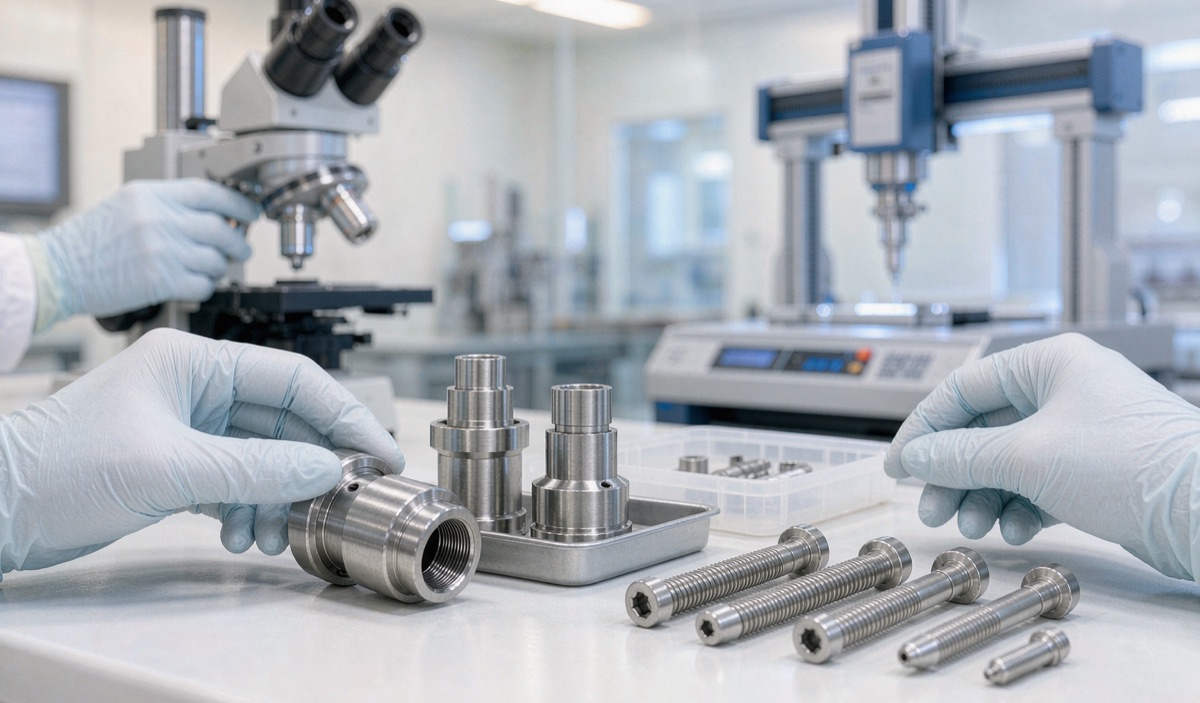
Medical device manufacturing combines the worst of both worlds for a machinist: miniature geometries, exotic materials, surface finishes measured in nanometres, and documentation requirements borrowed from aviation. Yet the industry's dependence on CNC machining keeps growing — instruments, implants, diagnostic equipment and robotic surgery systems all rely on precisely machined metal components.
Renjiu Machinery supplies CNC machined parts for medical equipment and instrument customers. Here is what buyers in this sector should know before placing an order.
| Segment | Example Parts | Materials | Critical Demand |
|---|---|---|---|
| Surgical instruments | Handles, jaws, tip assemblies, trocars | 304/316L stainless, 17-4PH | Edge quality, repeatable geometry |
| Orthopedic implants & trials | Test pieces, guides, trial stems | Titanium Ti-6Al-4V, CoCr | Surface finish, burr-free |
| Diagnostic equipment | Sensor housings, rotor assemblies, frames | Aluminum 6061/7075 | Balance, dimension stability |
| Dental | Abutment blanks, guide sleeves | Titanium, PEEK | Micro-tolerances ±0.01 mm |
| Lab automation | Pump parts, valve bodies, robotic arms | Aluminum, stainless, POM | Cleanliness, chemical resistance |
Corrosion resistance plus autoclavability make these the default for instruments. Machining 316L demands sharp tooling and steady feeds to avoid work hardening — a common failure mode at inexperienced shops.
Biocompatible, strong, light. Used for implant-adjacent tools and trials. Its low thermal conductivity means heat concentrates at the cutting edge; process control is everything.
Increasingly common for trial instruments and equipment internals. Plastic machining is a different discipline — tool geometry, clamping and thermal expansion all differ from metal. Our materials page lists the plastics we routinely process.
Just as important: no burrs, no sharp edges, no tool marks in patient-contact zones. Deburring and edge treatment are process steps, not afterthoughts.
Medical buyers should define the documentation package at RFQ stage:
Our quality control workflow supports this level of reporting for every shipment, not only for first articles.
Fast prototype iterations in final material — typically 5–10 working days for instrument-scale parts. DFM feedback focuses on surgical usability: knurling, ergonomic radii, weight reduction.
Small batches with 100% inspection on critical characteristics, passivation and polishing managed in-house or with certified partners.
Fixed process windows, retained fixtures and lot traceability. Combined processes — for example injection molded handles with machined metal inserts — reduce assembly steps and cost.
As instruments get less invasive, features get smaller: ∅0.3 mm holes, 0.1 mm-wide slots, 0.05 mm-radius internal corners. Successful micro-machining is a system property:
We manufacture instruments, trials, guides and equipment components. Permanent implants require site-specific regulatory controls we support with documentation, but final process validation stays with the device OEM — we are transparent about this boundary.
Send a physical sample or a roughness spec. We match bead-blast, polish and textured finishes against reference coupons approved by you before production.
PEEK moves: we machine with temperature-compensated strategies, de-stress semi-finishes, and hold final tolerances at 20°C inspection temperature — the same conditions your assembly area should use.
Dedicated tooling and stations for stainless vs titanium vs plastics, documented cleaning between material changes, and material-segregated packing.
None. Instrument development runs of 10–50 pcs are routine; series pricing starts where volumes justify setup amortisation, and we'll show you the curve honestly.
Send your 2D/3D files and get a detailed quotation within 24 hours — DFM feedback, material and tolerance advice, and lead time included. Prototypes from 1 piece, no minimum order.
Request a Free Quote → WhatsApp Us
Or email jasonhardware@foxmail.com · Reply within 24 hours, Monday–Saturday
Contact: Mr Zhang
Phone: +86-18368240367
E-mail: jasonhardware@foxmail.com
Add: No.16 Laoshan Road, Beilun District, Ningbo City
LiveChatclose
 Send Email
 WhatsApp