
Beryllium Copper: When You Actually Need It
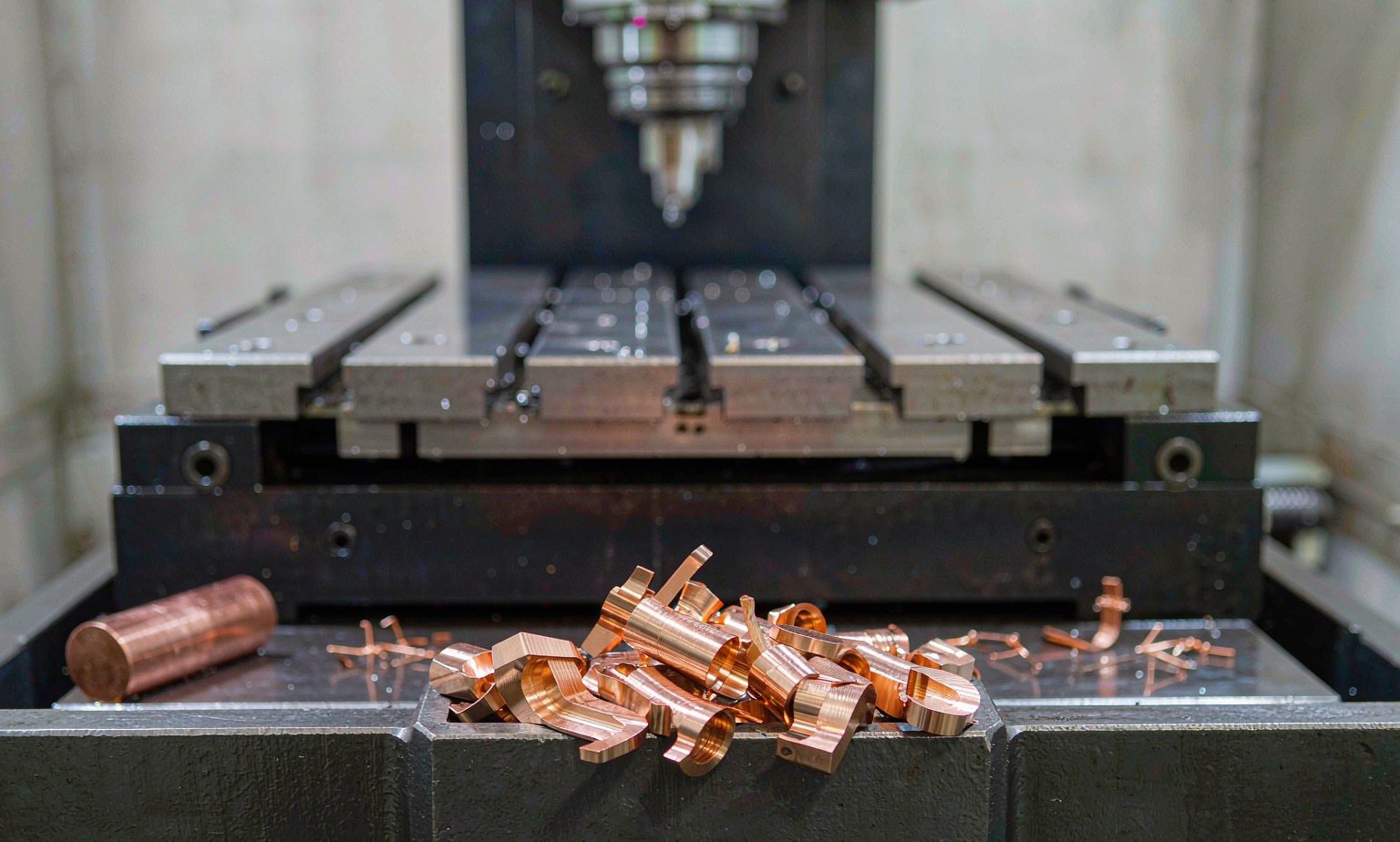
Beryllium copper is the alloy that gets specified by habit. A connector spring worked in C17200 fifteen years ago, so it stays C17200 on every drawing since — at five to seven times the bar price of brass, with a dust hazard attached and a heat treatment nobody upstream planned for. Meanwhile the part in question often needs only a third of the strength it is being given.
This article is the other direction: the four properties that actually justify beryllium copper, the numbers behind each of them, the tempers that change the answer completely, and the machining sequence (age first or machine first) that decides whether your ±0.01 mm holds. It also covers the safety rules that make a BeCu job different from a brass job, and the cheaper alloys that solve most of the same problems. If you are quoting or designing a copper-alloy part right now, the decision tables below are the ones worth keeping.
First: "beryllium copper" is not one material
Four alloys carry the name, and they behave differently enough that a drawing saying only "BeCu" is an incomplete drawing.
C17200 (CuBe2, Alloy 25) — 1.80–2.00% beryllium, the workhorse. Highest strength of the family after aging (up to roughly 1,300 MPa UTS), 22–28% IACS conductivity, excellent fatigue life. This is what most people mean.
C17300 (Alloy 165) — same family with 0.25–0.5% lead added for machinability. Being phased out in many supply chains for RoHS reasons, but still common in legacy drawings.
C17510 and C17500 — nickel-beryllium, only 0.4–0.7% Be. Lower strength (roughly 700–900 MPa aged) but 45–60% IACS conductivity, which is two to three times C17200. If your problem is heat, not force, this is the cheaper and better answer.
C17410 — 0.15–0.5% Be strip alloy, used almost exclusively for stamped connectors. You will rarely see it on a machined part.
The practical consequence: "BeCu" on a drawing should be replaced by a UNS number plus a temper. C17200-TH04 and C17200-TB00 machine and price completely differently, as the tables below show.
The four properties that justify the premium
Beryllium copper earns its price in exactly four situations. If your part does not sit in one of them, one of the substitutes further down will do the job for less.
1. Spring force and electrical conductivity in the same part. This is the classic case and still the strongest one. A contact finger needs to push with 1–3 N and carry current without heating. Phosphor bronze gives you the spring but only 15% IACS; pure copper gives you conductivity but yields at 70 MPa. Aged C17200 delivers 1,100+ MPa and 25% IACS at once — no other commercial alloy covers both ends of that trade-off in a machined part.
2. Non-sparking and non-magnetic in the same part. BeCu tools and components are used in explosive atmospheres and around magnetic-sensitive instrumentation. Aluminium bronze is also non-sparking but is ferromagnetic-adjacent in some grades and machines poorly; 316 stainless is non-magnetic annealed but becomes mildly magnetic after cold working. Aged BeCu stays non-magnetic and non-sparking, which is why it appears in downhole tools, fuel-handling hardware and MRI-adjacent mechanisms.
3. Thermal conductivity where the tool steel is the bottleneck. C17200 at 105–130 W/m·K is roughly three times H13 tool steel. Injection mold cores and slides made in BeCu cut cycle time on thick-walled parts by pulling heat out of the cavity faster — the classic 20–30% cycle reduction on a 4 mm wall.
4. Fatigue at high cycle counts in a small envelope. Spring contacts that see 10⁶–10⁷ cycles, or flexing elements that must not take a set. BeCu's fatigue strength at 10⁷ cycles sits around 200–280 MPa depending on temper, well above phosphor bronze at comparable section size.
Beryllium copper against the alloys people substitute for it
This is the table to bring to a design review. Prices are indicative bar stock for small quantities in 2026 and move with the copper market; the ratios are what matter.
| Alloy | UNS | Typical bar price | vs C36000 brass | Conductivity | Peak hardness |
|---|---|---|---|---|---|
| Free-cutting brass | C36000 | $9–13/kg | 1.0× | 28% IACS | ~90 HRB |
| Phosphor bronze | C51000 | $16–22/kg | ~1.7× | 15% IACS | ~92 HRB |
| Tellurium copper | C14500 | $18–24/kg | ~2× | 90–95% IACS | ~45 HRB |
| Aluminium bronze | C95400 | $14–19/kg | ~1.5× | 12% IACS | ~180 HB |
| BeCu (aged) | C17200 | $55–85/kg | 5–7× | 22–28% IACS | 38–42 HRC |
| NiBe (aged) | C17510 | $60–90/kg | 5–7× | 45–60% IACS | ~30–38 HRC |
Read the last two rows together. C17510 costs the same per kilogram as C17200 but carries twice the conductivity and much less strength — and, importantly, less beryllium, which simplifies the health-and-safety paperwork in some jurisdictions. Choosing between them is a one-line calculation: if the part carries more than a few amps and does not need to push back hard, take C17510.
Temper decides everything, including the quote
Beryllium copper is bought in a condition, not a grade. The letter codes on the mill certificate are not decoration — they set hardness, machinability and whether you need a furnace afterwards.
| Temper | Meaning | Hardness (typical) | What it is for |
|---|---|---|---|
| TB00 (A) | Solution annealed | ~60–85 HRB | Heavy forming, then age to full strength |
| TD01 / TD02 / TD04 | Cold worked ¼ / ½ / hard | ~90 HRB to 20 HRC | Machined parts that will be aged after machining |
| TF00 (AT) | Annealed + aged | 36–42 HRC | Full strength, no post-machining heat treat |
| TH01 / TH02 / TH04 | Cold worked + aged | 34–44 HRC | Maximum strength and spring; buy it finished |
The aging treatment itself is unglamorous: hold at 300–330 °C for 2–3 hours, air cool. No quench, no atmosphere control needed at that temperature. What catches people is the dimensional change — aging shrinks the part 0.02–0.05% linearly, which on a 100 mm bore is 20–50 µm. That is the same order as the tolerance you are trying to hold.
Machining beryllium copper: it is not brass, and it is not stainless
BeCu in the annealed and quarter-hard conditions cuts like a hard brass with a tendency to smear. In the aged condition it behaves closer to a soft stainless — the chip breaks, but cutting forces climb and the edge wears faster. Starting parameters for carbide, wet:
| Condition | Turning speed | Feed | Milling speed | Behaviour |
|---|---|---|---|---|
| TB00 / TD01 | 150–200 m/min | 0.15–0.25 mm/rev | 200–280 m/min | Gummy; built-up edge if the rake is neutral |
| TD04 | 120–170 m/min | 0.12–0.20 mm/rev | 160–240 m/min | Clean chips, watch flank wear |
| TH04 / TF00 (38–42 HRC) | 90–140 m/min | 0.10–0.18 mm/rev | 120–180 m/min | Higher forces, notching at the depth-of-cut line |
Four shop-floor rules that matter more than the table:
Sharp, positive geometry. A worn or honed edge rubs instead of cutting, and BeCu work-hardens at the rub line. Change inserts on flank wear rather than on failure — the window between "still cutting" and "smearing" is short.
Never dry. Flood coolant does two jobs here: it controls the built-up edge and it suppresses respirable dust, which is the actual hazard discussed below. Dry machining beryllium copper is a procedure problem, not a productivity choice.
Expect spring-back on thin sections. Below about 1.5 mm wall, aged BeCu deflects under clamping and springs back after the cut. Rough, stress-relieve if the tolerance is under ±0.01 mm, then finish in a soft-jaw fixture with low clamping pressure.
Deburr wet, and do not grind. Grinding and dry abrasive work on BeCu generates the fine dust that the exposure limits are written for. If a surface must be ground, it belongs in a controlled operation with local exhaust ventilation, not on an open bench.
Age before machining, or machine before aging?
This single decision creates more scrap on BeCu parts than any other, and it is usually made by default rather than on purpose. The two sequences:
Buy TH04, machine finished. The material arrives at 38–42 HRC and 22–28% IACS. You machine it once and ship it. Cost: the mill's premium for aged stock and slower cutting. Best for: small parts, simple geometry, quantities where a heat-treat lot charge would dominate, and anything with a tolerance looser than ±0.025 mm.
Buy TD04 or TB00, machine oversize, age, finish. You machine with a 0.05–0.15 mm allowance on critical features, send the lot for aging at 315 °C / 2–3 h, then take the finishing pass at final hardness. Cost: two setups plus a heat-treat lot charge (typically a few hundred dollars, not per piece). Best for: thin walls, tight bores, parts with a flatness or concentricity callout under 0.02 mm, and any part where the conductivity spec is verified after aging.
The arithmetic that decides it: aging moves features by 0.02–0.05% of length. On a 50 mm span that is 10–25 µm — inside a ±0.05 mm tolerance, outside a ±0.01 mm one. Add the distortion from thin walls and the practical rule is simple: if the tightest tolerance is under ±0.02 mm, or any wall is under 2 mm, finish after aging.
The safety rules that are not optional
Beryllium is a respiratory sensitiser and a carcinogen. That statement applies to respirable dust and fume, not to the solid bar or the finished part — you can handle C17200 all day. The hazard appears the moment a tool turns it into particles small enough to inhale.
Compliance numbers to put in the job file: OSHA permissible exposure limit is 0.2 µg/m³ as an 8-hour time-weighted average with a 2.0 µg/m³ short-term limit; ACGIH recommends 0.05 µg/m³. EU classification puts beryllium as a category 1B carcinogen, and the alloy dust inherits that classification.
What this means in a machine shop, in order of effectiveness: wet machining with flood coolant (keeps dust bound in the fluid); local exhaust ventilation at any operation that cannot be wet, plus at deburring benches; no dry grinding, sanding or abrasive blasting of BeCu without a controlled enclosure; no compressed air cleaning of chips or parts; segregated chip collection with the swarf labelled; no eating, drinking or smoking in the area; gloves for repeated handling, since skin sensitisation is documented; and — where local rules require it — air monitoring and medical surveillance for operators regularly assigned to the alloy.
A shop that already machines leaded brass has most of this infrastructure. A shop that has never run a regulated alloy usually does not, which is a legitimate reason a supplier declines a BeCu RFQ or quotes it with a setup surcharge. It is not padding.
Where the price actually comes from
On a like-for-like part, aged BeCu typically quotes 2.5–4× the same geometry in free-cutting brass. That multiplier breaks down roughly as: material 5–7× per kilogram (the dominant line on small parts), cutting time 1.4–1.8× because speeds are lower and edges wear faster, tooling 2–3× per part, and finishing/deburring slightly higher because the burr is tougher. On a 200 g part with simple turning, material is around half the piece price; on a 20 g contact pin, material drops below a quarter and machine time dominates.
Two levers reduce the number without touching the design. First, buy the temper that lets you machine once — a lot charge for aging plus a second setup often costs more than the aged-stock premium on quantities under a few hundred pieces. Second, do not over-specify conductivity: a 22% IACS callout on a part that only needs to be "not an insulator" invites C17200 where C17510, at similar bar price but faster cutting and less regulatory friction, would pass every functional test.
If you want to see how the material line lands against machine time on your own geometry, the CNC machining cost calculator takes stock size, removal volume and material class and returns a line-item estimate — including the copper-alloy multipliers used above. For the general cost structure behind any alloy, material cost versus machining cost explains which line dominates at which part size.
When you should not use it
Five substitutions that solve the same problem for less, in rough order of how often they apply:
Phosphor bronze C51000 — if the part needs spring temper and corrosion resistance but carries no current. A fifth of the price, no beryllium paperwork.
Tellurium copper C14500 — if the part is a conductor first and a structure second: busbars, welding electrodes, high-current terminals. 90%+ IACS and it machines like free-cutting brass.
NiBe C17510 — if conductivity matters more than strength, as covered above. Same price, less beryllium, twice the conductivity.
Aluminium bronze C95400 — if the requirement is non-sparking and wear resistance at large section size, e.g. hammer heads or valve seats. Cheaper and far more forgiving.
Stainless 17-4 PH — if the requirement is strength and corrosion resistance with no electrical or thermal role at all. This is where a lot of unnecessary BeCu specs should have landed; see 17-4 PH machining and heat treatment notes for the H900–H1150 trade-off.
One more: if the reason for BeCu is EMI shielding or contact spring force, question whether the part should be machined at all. Stamped C17410 strip is the volume answer; machining is for prototypes, low volume, or geometries a die cannot form. That boundary is worth checking before a BeCu machining quote goes out — the comparison logic is the same one in brass versus copper for CNC machining, where conductivity and machinability pull in opposite directions.
What to put on the purchase order
BeCu jobs fail on documentation more often than on cutting tools. A complete line reads like this: UNS number (C17200); temper (TD04, or TH04 if buying finished); beryllium range or a mill certificate with chemistry; conductivity requirement in % IACS with the test method (usually ASTM E1004 eddy current); hardness range; grain direction if the part is formed or loaded in bending; heat-treat specification and whether aging is in the supplier's scope; and a note that chips and swarf will be segregated.
A drawing that says "Beryllium Copper, 38 HRC min" with nothing else will get quoted three different ways by three suppliers — one assuming aged stock, one assuming age-after-machining as a separate line, one assuming solution-annealed bar with the heat treat left to you. The variance is not dishonesty; it is an under-specified drawing. If you want a line-item quote that separates material condition, machining, aging and inspection, this breakdown of a CNC quotation shows exactly which lines to compare between suppliers.
Frequently asked questions
Is beryllium copper dangerous to machine?
The solid alloy is safe to handle. The hazard is respirable dust and fume from machining, grinding or abrasive work, which can cause beryllium sensitisation and chronic beryllium disease. Wet machining with flood coolant, local exhaust at dry operations, no compressed-air cleaning and segregated swarf control the exposure. OSHA sets 0.2 µg/m³ as an 8-hour average. Any shop quoting BeCu should be able to describe its dust controls without looking them up.
Can beryllium copper be machined to ±0.005 mm?
Yes, but only with the right sequence. In the aged condition (TH04) C17200 turns and mills cleanly and holds ±0.005 mm on rigid setups. The limit is not the cutting — it is aging shrinkage of 0.02–0.05%, so any tolerance under ±0.02 mm should be finished after the aging cycle rather than before. Thin walls under 2 mm also need a stress-relief step between roughing and finishing.
How much more expensive is a beryllium copper part than brass?
Bar stock runs 5–7× the price per kilogram of C36000 brass, and the finished part typically quotes 2.5–4×. On small parts (under 50 g) material is the dominant line; on larger parts the gap narrows because machine time is a bigger share of both prices. Buying aged stock instead of adding a heat-treat lot charge usually saves money below a few hundred pieces.
Does beryllium copper need heat treatment after machining?
Only if you started from an unaged temper. TB00, TD01, TD02 and TD04 all require aging at 300–330 °C for 2–3 hours to reach full strength and conductivity. TH01/TH02/TH04 and TF00 arrive already aged and need nothing further. If a drawing specifies a hardness above 34 HRC and does not name the temper, ask — the answer changes the routing and the price.
What is the difference between C17200 and C17510?
Both are beryllium coppers but trade strength for conductivity differently. C17200 (1.8–2.0% Be) ages to 1,100–1,300 MPa and 22–28% IACS; C17510 (0.4–0.7% Be, with nickel) ages to roughly 700–900 MPa and 45–60% IACS. For current-carrying parts that do not need high spring force, C17510 is the better and less regulated choice; for contact springs, C17200.
Can beryllium copper be welded or soldered?
Soldering and brazing are straightforward with proper flux, and this is how most BeCu contact assemblies are joined. Welding is possible but degrades the aged properties in the heat-affected zone and generates fume that must be extracted — if the joint is structural, design it as a mechanical or brazed connection instead. Any welding on BeCu belongs in a controlled operation with fume extraction, not a general fabrication bay.
Is there a beryllium-free alternative with similar properties?
Close, not equal. CuNiSi (C70250) reaches 600–800 MPa with 35–45% IACS and no beryllium; phosphor bronze covers the spring side at lower conductivity; Spinodal and CuTi alloys sit in between at higher cost and limited availability. None matches aged C17200's combination of 1,100+ MPa and 25% IACS, which is why the alloy persists despite the regulatory burden.
Working on a copper-alloy part and unsure whether BeCu is justified? Send the drawing to Renjiu Machinery and we will come back within 24 hours with a line-item quote in the temper you actually need — and, where a substitute alloy would meet the function, the alternative price beside it. MOQ 1 piece, prototypes in 5–12 days, CMM dimensional report with every first article. Request your quote →
Need this part made to your drawing?
Send your 2D/3D files and get a detailed quotation within 24 hours — DFM feedback, material and tolerance advice, and lead time included. Prototypes from 1 piece, no minimum order.
- ISO 9001 quality system · full inspection report with every shipment
- CNC machining, injection molding, die casting & sheet metal under one roof
- NDA available on request — your drawings are never shared
Request a Free Quote → WhatsApp Us
Or email jasonhardware@foxmail.com · Reply within 24 hours, Monday–Saturday
 Send Email
 WhatsApp