






jasonhardware@foxmail.com+86-0574-58202256
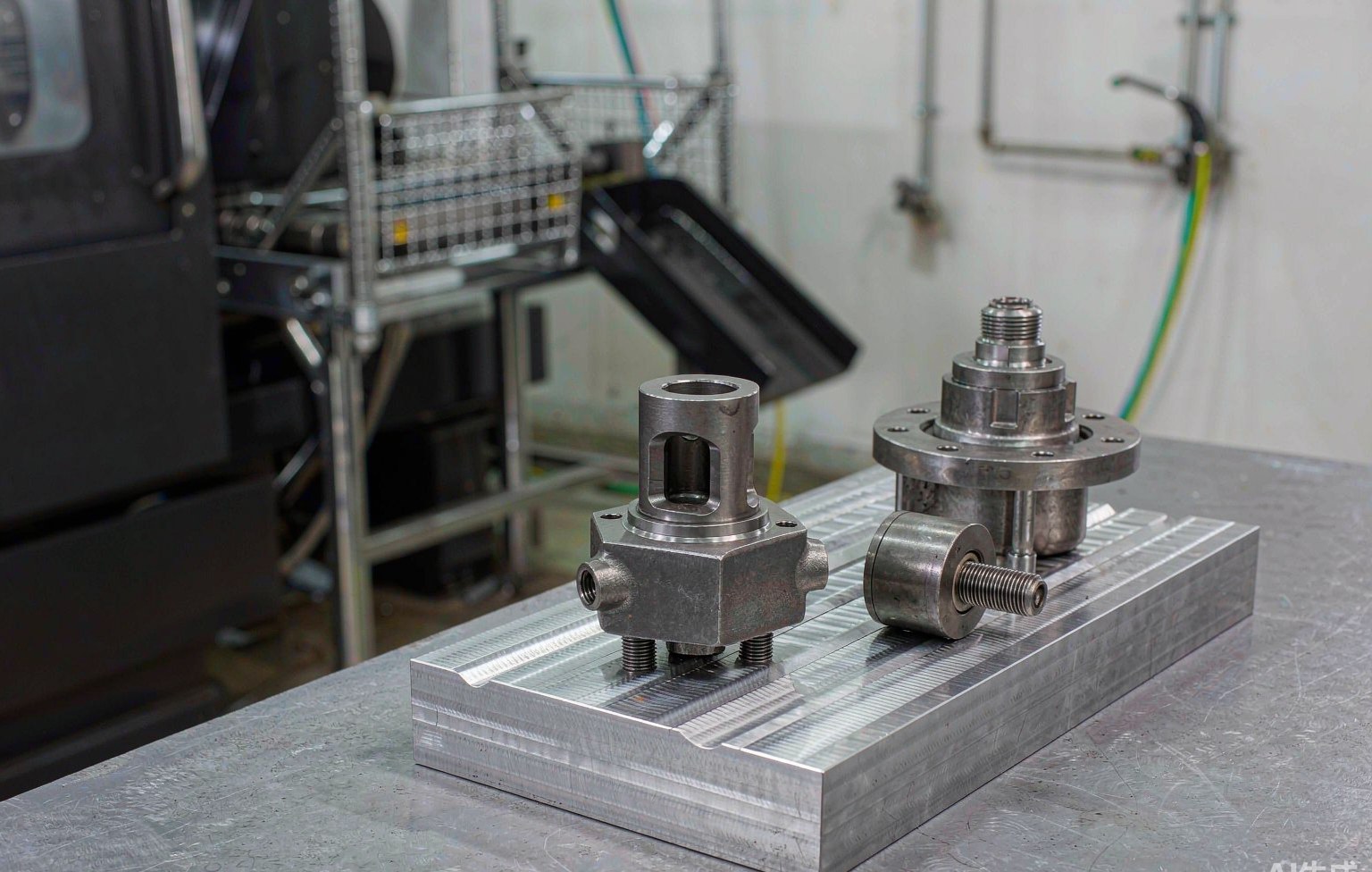
17-4 PH is the stainless steel we reach for when a customer needs 316-level corrosion resistance on the datasheet and three times 316's strength on the same line — valve internals, sensor housings, firearm and aerospace hardware, pump shafts, surgical instrument blanks. It is also the stainless we get the most quoting questions about, because its whole personality depends on a heat-treatment decision that happens after machining: the "condition" (H900, H1025, H1150…) printed at the end of the material callout. Specify it carelessly and you get parts that miss hardness, bores that shrank out of tolerance after aging, or threads that galled the first time a technician ran a screw into them.
This page is our shop notes on 17-4 PH machining and its heat treatment: what the alloy actually is, the full condition chart with real numbers, why we machine it in Condition A and age afterwards, how much it shrinks during aging (with a planning table you can apply to a drawing), the cutting and tapping practices that keep it predictable, and a decision table against 316, 15-5 PH and 440C. This is a grade-specific deep dive — for the general question of when heat treatment sits in the process chain, start with our heat-treatment sequencing guide, then come back here for the 17-4 specifics.
17-4 PH is a precipitation-hardening martensitic stainless steel, standardised as UNS S17400, EN 1.4542, and covered by ASTM A564 (bar), A693 (plate) and a long list of AMS specifications for aerospace stock. The name decodes the alloy: roughly 17% chromium and 4% nickel, with 3–5% copper. The copper is the interesting part. In the solution-treated state that copper sits dissolved in the matrix; age the steel at 480–620 °C and it precipitates as fine copper-rich particles that block dislocation movement — which is how a "soft" solution-treated part gains 300–400 MPa of strength in a simple furnace cycle with no quench and no carburising gas.
One naming trap worth clearing up: "17-4" and "630" are the same alloy (630 is the ASTM cast/wrought designation), and you will also see it as X05CrNiCuNb16-4 or SUS630 on Asian drawings. Same metal, same conditions, different paperwork.
The heat-treatment condition is a single number — the aging temperature in °F. Higher aging temperature = lower strength, but better toughness and better stress-corrosion behaviour. These are typical minimum values for bar per ASTM A564; always verify against the certificate for the actual heat:
| Condition | Aging treatment | UTS (min) | Yield (min) | Hardness (typ) | Elongation | Best for |
|---|---|---|---|---|---|---|
| Condition A | Solution treated 1040 °C, air cooled | ~1100 MPa | ~1000 MPa | 32–36 HRC | ~15% | The machining state — not a service condition |
| H900 | 480 °C × 1 h, air cool | 1310 MPa (190 ksi) | 1170 MPa (170 ksi) | 40–48 HRC | 10% | Maximum strength, minimum toughness |
| H925 | 495 °C × 1 h | 1170 MPa | 1070 MPa | ~43 HRC | 10% | Slight toughness gain over H900 |
| H1025 | 550 °C × 1 h | 1070 MPa (155 ksi) | 1000 MPa (145 ksi) | 35–39 HRC | 12% | The workhorse: strength/toughness balance |
| H1075 | 580 °C × 1 h | 1000 MPa (145 ksi) | 860 MPa (125 ksi) | 33–37 HRC | 13% | General structural hardware |
| H1100 | 595 °C × 1 h | 965 MPa | 795 MPa | ~34 HRC | 14% | Transitional |
| H1150 | 620 °C × 1 h | 930 MPa (135 ksi) | 725 MPa (105 ksi) | 28–32 HRC | 16% | Best toughness and chloride-SCC resistance |
| H1150D | Double aged (H1150 + re-age) | ~860 MPa | ~725 MPa | ~30 HRC | 16% | Maximum toughness for critical parts |
Two reading notes on this table. First, Condition A is not a delivery condition for a finished part — it is the state the bar arrives in and the state you machine in. A part that ships "as-machined, Condition A" will age itself unpredictably in service (welding nearby, friction heating, even shop-floor warmth over years) and its dimensions will drift. Second, the strength range across conditions is enormous — H900 gives you 60% more yield than H1150 — so the condition number on the drawing is doing more work than the alloy name. When a drawing says "17-4 PH" with no condition, that is a question for the customer, not an assumption for the supplier to make.
Almost all 17-4 machining happens in Condition A, at roughly 32–36 HRC, and the whole process chain is arranged around that fact:
For context, here is how 17-4 sits against the other common machined stainless grades (machinability index, 303 free-machining = 100):
| Grade (condition) | Machinability index | Hardness when machined | Watch out for |
|---|---|---|---|
| 303 | ~100 | ~85 HRB | Poor corrosion resistance; sulfide inclusions hurt polish and fatigue |
| 304 | ~60 | ~85 HRB | Work hardening, stringy chips, galling |
| 316 | ~55 | ~90 HRB | Same as 304 plus more abrasive; slower everything |
| 17-4 PH (Condition A) | ~48 | 32–36 HRC | Tapping, galling, aging shrinkage after machining |
| 17-4 PH (H900) | ~15 | 44+ HRC | Essentially a grinding job — avoid entirely |
| 440C (annealed → hardened) | ~45 annealed | ~95 HRB → 58 HRC | Distortion and scale in hardening; finishing almost all after hardening |
The comparison against our 303 vs 304 vs 316 comparison is useful for expectations: 17-4 in Condition A machines a little slower than 316, and the delta shows up mostly in the threading and finishing operations, not in roughing. The big cost difference versus the austenitic grades is not the cutting — it is the heat-treatment step and the dimensional discipline around it.
This is the single most expensive thing buyers and junior programmers get wrong with 17-4. When the part ages, the precipitation of copper phases contracts the material. The linear shrink is small in percentage terms but enormous in tolerance terms, and it scales with the aging temperature:
| Aging condition | Typical linear shrink | On a 200 mm length | On a Ø25 mm bore | On a Ø100 mm flange OD |
|---|---|---|---|---|
| H900 | ~0.04–0.05% | 0.08–0.10 mm | 0.010–0.013 mm | 0.04–0.05 mm |
| H1025 | ~0.05% | ~0.10 mm | ~0.013 mm | ~0.05 mm |
| H1075 | ~0.06% | ~0.12 mm | ~0.015 mm | ~0.06 mm |
| H1150 | ~0.08–0.10% | 0.16–0.20 mm | 0.020–0.025 mm | 0.08–0.10 mm |
Values are typical mill-and-handbook figures for small sections; the actual shrink depends on section size, aging soak and the heat treater's furnace practice — always confirm the compensation with whoever runs the furnace, and keep test coupons with the batch.
How we apply this in practice:
One more subtlety: aging also relieves a little of the machining residual stress, so flatness can move slightly even where the linear shrink is compensated. For thin 17-4 parts with flatness calls under 0.05 mm, we rough, semi-finish, age, then finish — the standard rest-and-recut logic that any stress-relieved alloy demands.
17-4 leaves the machine bright and active, and it will surface-rust in a humid shop or a salt-laden environment if it is not passivated. Standard practice is ASTM A967 — nitric or citric passivation — after all machining and heat treatment are complete. Three practical notes:
| If the part needs… | Choose | Why |
|---|---|---|
| High strength + ordinary corrosion exposure (valve stems, fasteners, sensor bodies, actuators) | 17-4 PH (H1025/H1075) | ~3–5× the yield of 316 at similar atmospheric corrosion performance; machineable in Condition A |
| Maximum strength in a small part, benign environment | 17-4 PH (H900) | 190 ksi class strength from bar stock; mind the toughness and SCC caveats |
| Corrosion in chlorides first, strength second | 316 / 316L | Better pitting resistance; no aging step; but ~205 MPa yield means cross-sections grow |
| Aerospace forging-grade toughness through the section | 15-5 PH | Same family chemistry, vacuum remelted; better through-thickness ductility — the aerospace successor for forgings |
| Maximum hardness / wear (bearings, blades, dies) | 440C | 58–60 HRC achievable; gives up corrosion resistance and is far harder to machine after hardening |
| Food, pharma or marine wetted parts with strength needs | 17-4 or 316, case by case | 17-4 passivates well but pits before 316; the medium and cleaning chemistry decide |
A note on 15-5 PH, because RFQs increasingly name it: mechanically it overlaps 17-4 almost exactly, and in bar form either will usually work. The difference is metallurgical cleanliness — 15-5 is produced with refined remelting practice that gives better ductility and toughness through the thickness of heavy sections. If your drawing comes from an aerospace prime, the 15-5 callout is likely frozen; do not substitute without written approval. For commercial parts, quote both if the stock lead times differ — 17-4 is stocked far more widely, including every Chinese machining cluster, and the price gap is real but modest (typically 5–15%).
17-4 bar typically runs 1.5–2.5× the price of 304 per kilogram, and 316 runs between them. On a material-heavy part that premium dominates the piece-price delta. But the structural costs of a 17-4 part are elsewhere:
For most small machined parts — where machining time dominates — the total 17-4 premium over a 316 version lands in the 10–25% band, and it buys three to five times the yield strength. You can model where your own part sits with our free CNC machining cost calculator, then send the drawing for a firm number: we quote 17-4 regularly and will flag the shrink-compensation and finishing decisions up front rather than after the first batch.
Our standard process for a 17-4 PH part, which is worth sharing because it is the checklist we wish every RFQ arrived with:
The same discipline, expressed as a general principle rather than a grade-specific recipe, is in our sequencing guide; the 17-4-specific numbers above — shrink table, condition chart, machinability index — are what turn that principle into a first-pass-good batch. For buyers working across materials, our aerospace machining overview shows how 17-4, 15-5 and titanium parts share a quality system, and our Ra chart covers what finish to expect from aged 17-4 after grinding versus turning.
Practically, no — beyond light grinding, EDM or single light turning passes with premium tooling, H900 at 44+ HRC destroys carbide cutters and makes tapping impossible. The economical route is always: machine in Condition A, age, then finish the few features that need it by grinding or honing. If a drawing arrives as a finished part in H900 with tight tolerances, we plan post-aging finishing into the quote from the start.
It can. With ~15–17.5% chromium and no molybdenum, 17-4 passivates well but sits below 316 (and slightly below 304) in pitting resistance. Unpassivated chips and parts will show surface rust in a humid shop. After ASTM A967 passivation it performs well in atmospheric and many washdown environments; in continuous chloride exposure, specify H1025+ for SCC resistance and consider 316 instead if corrosion, not strength, is the governing requirement.
Expect roughly 0.04–0.05% linear contraction at H900 growing to 0.08–0.10% at H1150. On a 200 mm dimension that is 0.08–0.20 mm — several times a typical ±0.05 mm tolerance, which is why the shrink must be compensated or the feature finished after aging. The exact value depends on section size and furnace practice, so we confirm compensation with the heat treater and keep coupons with each batch.
Same family of chemistry and nearly identical strength in the same conditions. 15-5 is made with refined (vacuum) remelting practice, which improves toughness and ductility through the thickness of heavy sections — it is the standard answer for aerospace forgings. In ordinary bar machining for commercial parts, either usually works; for aerospace drawings the callout is frozen and substitution needs approval.
H900 for maximum strength in benign environments; H1025 for the common strength/toughness balance; H1075 for general hardware; H1150 (or H1150D) for best toughness and chloride-SCC resistance. If you are unsure, tell us the load case and environment — the condition is a one-word change on the drawing but a large change in part behaviour, and it is much cheaper to choose it correctly than to re-heat-treat a batch.
Yes, but the weld and heat-affected zone lose the aged properties, and recovery requires a full re-solution-treatment plus re-aging cycle. For small machined parts, a threaded, press-fit or brazed joint usually beats welding on total cost; where welding is unavoidable (large housings, repair work), plan the re-heat-treatment and the resulting dimensional change into the process from the beginning.
Need 17-4 PH parts quoted with the heat-treatment thinking included? Send us your drawing with the condition callout (or without — we will ask). We machine in Condition A, compensate aging shrinkage, finish critical features after aging, and ship with full material, hardness and passivation certificates.
Request a free quote → or try our instant cost calculator.
Send your 2D/3D files and get a detailed quotation within 24 hours — DFM feedback, material and tolerance advice, and lead time included. Prototypes from 1 piece, no minimum order.
Request a Free Quote → WhatsApp Us
Or email jasonhardware@foxmail.com · Reply within 24 hours, Monday–Saturday
Contact: Mr Zhang
Phone: +86-18368240367
E-mail: jasonhardware@foxmail.com
Add: No.16 Laoshan Road, Beilun District, Ningbo City
LiveChatclose
 Send Email
 WhatsApp