






jasonhardware@foxmail.com+86-0574-58202256
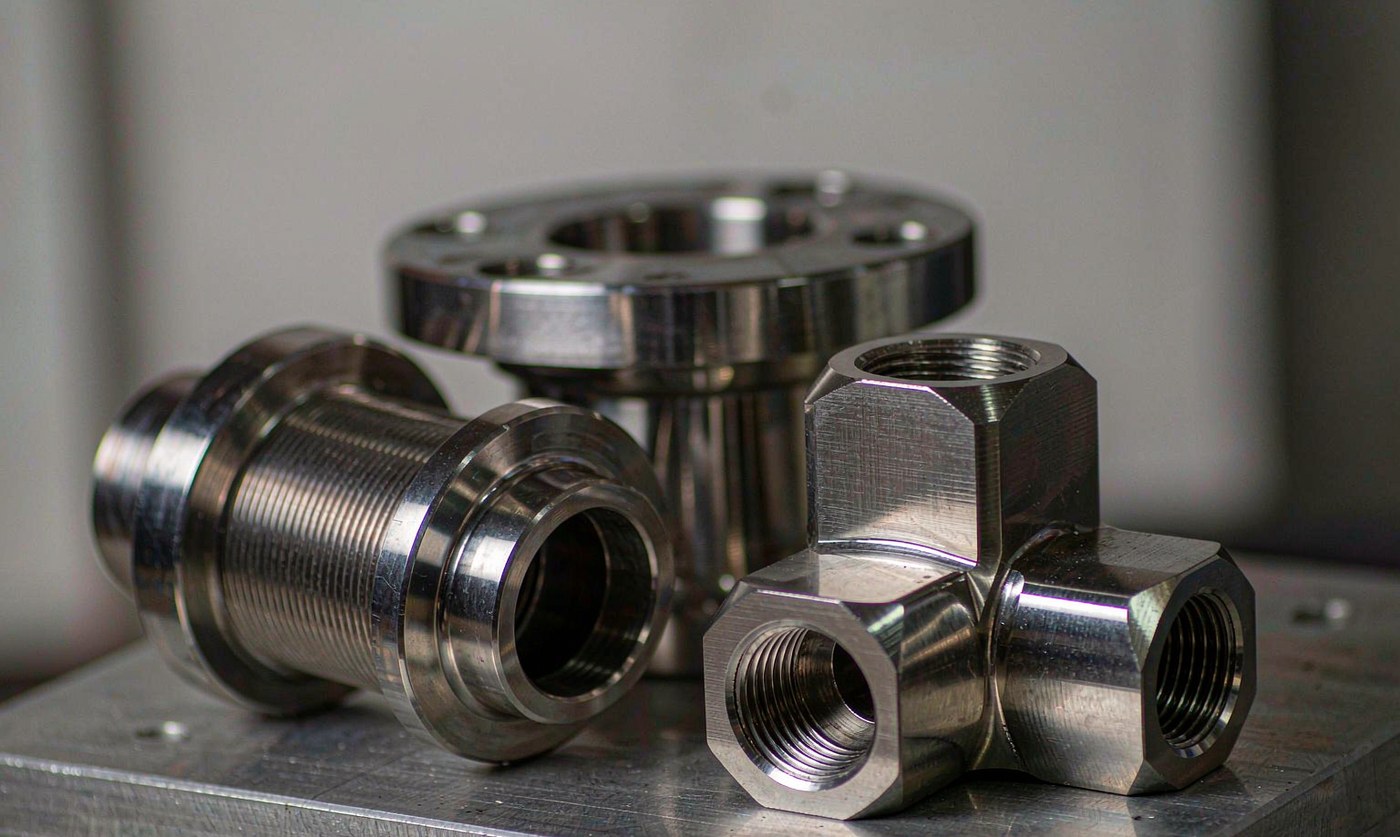
316L is not a better grade of 316. It is 316 with a carbon ceiling lowered from 0.08% to 0.03%, and almost everything people believe about the two grades follows from that single number: the L grade is weaker on the datasheet, it resists weld decay, it costs about the same, and it machines a shade gummier. The confusion starts because mills routinely sell one heat certified to both grades — 316/316L — so a buyer can order "316" for years and never learn that the material in the crate was actually L.
This page is our shop notes on the 316L vs 316 question as it actually arrives in a machine shop: the chemistry and mechanical limits side by side, what the lower carbon really does during welding and in service, how the dual-certificate wording should be read, what changes on the shop floor (cutting data included), the codes that make L mandatory, the four other 316 variants that get confused with it, and the one verification problem that catches even experienced inspectors — that a handheld XRF gun cannot see carbon at all. For the wider family picture (303 vs 304 vs 316, machinability and corrosion trade-offs), start with our stainless steel machining comparison and come back here for the 316-versus-316L specifics.
Both grades share the same chromium, nickel and molybdenum ranges. Molybdenum at 2.0–3.0% is what separates the whole 316 family from 304 and gives it the chloride pitting resistance that made it the default for chemical, marine and medical hardware. Carbon is the only element that moves:
| Element (%) | 316 (S31600) | 316L (S31603) | 316H (S31609) | Why it matters |
|---|---|---|---|---|
| Carbon | ≤ 0.08 | ≤ 0.03 | 0.04–0.10 | Carbide precipitation and strength |
| Chromium | 16.0–18.0 | 16.0–18.0 | 16.0–18.0 | Passive film, pitting resistance |
| Nickel | 10.0–14.0 | 10.0–14.0 | 10.0–14.0 | Austenite stability |
| Molybdenum | 2.00–3.00 | 2.00–3.00 | 2.00–3.00 | Chloride pitting and crevice resistance |
| Nitrogen | ≤ 0.10 | ≤ 0.10 | ≤ 0.10 | Strength; also raises pitting resistance |
| Sulphur | ≤ 0.030 | ≤ 0.030 | ≤ 0.030 | Machinability vs weld quality |
Two numbers worth memorising. First, the gap is 0.05 percentage points of carbon — a few grams in a 10 kg bar. Second, PREN does not change: pitting resistance equivalent number (Cr + 3.3 Mo + 16 N) lands around 24–26 for both grades, because carbon takes no part in the passive film. If your problem is chloride pitting, 316L is not the fix; duplex 2205 (PREN ~26–28 with double the yield) or a super-austenitic like 904L is. The L is about heat, not about seawater.
Lower carbon means less interstitial solid-solution strengthening, so the L grade carries lower minimum properties. These are the ASTM A240 (plate) / A276 and A479 (bar) annealed limits:
| Property (annealed) | 316 | 316L | Gap |
|---|---|---|---|
| Tensile strength, min | 515 MPa (75 ksi) | 485 MPa (70 ksi) | −6% |
| Yield strength 0.2%, min | 205 MPa (30 ksi) | 170 MPa (25 ksi) | −17% |
| Elongation in 50 mm, min | 40% | 40% | — |
| Hardness, max | 95 HRB | 95 HRB | — |
| Typical annealed hardness | 150–170 HV | 145–160 HV | slightly softer |
The 17% yield gap is the part designers forget. In ASME BPVC Section II-D, the maximum allowable stress at room temperature is 20.0 ksi for 316 plate and 16.7 ksi for 316L — the L grade buys corrosion resistance with wall thickness, and the difference widens further at elevated temperature, where 316's allowables hold up better than 316L's. For a pressure-retaining part near its limit, "just use L, it's the same thing" can add 15–20% to the required section. For a bracket or housing at 2 MPa, nobody will ever notice.
Note also that the real world is kinder than the datasheet: mill certificates for 316L routinely report 240–280 MPa yield, well above the 205 MPa minimum for 316. That is why substituting L for 316 usually passes a strength check and why substituting 316 for L is the direction that actually gets rejected — not on strength, but on carbon.
Heat 316 into the 425–870 °C band and chromium carbides (M23C6) precipitate along the grain boundaries. Chromium is consumed locally to form those carbides, the adjacent metal drops below the ~12% needed to hold a passive film, and that narrow boundary becomes an anode. In a chloride or acid environment it corrodes first, as a groove or a knife-line attack — the classic "weld decay" that shows up as a rust streak 2–3 mm from a weld bead months after the part went into service.
The kinetics depend almost entirely on carbon content, because carbon is the limiting reactant:
This is the whole design logic in one line: L for anything welded that will see a corrosive service environment and will not be solution-annealed afterwards. Almost every welded 316 assembly qualifies, which is why the welding consumable for both grades is ER316L — the deposit is never annealed, so the filler is already low-carbon even when the base metal is not. A welded "316" part is, in practice, a 316/316L hybrid.
Dual certification is standard mill practice and the source of most substitution arguments. A heat stamped 316/316L has carbon at or below 0.03% and therefore meets 316 chemistry, but its certified minimum yield is the lower of the two — 170 MPa, not 205 MPa. The certificate declares the weaker of the two sets of minimums, whatever the actual test values say.
Practical consequences:
If the application is code-governed, write the UNS number (S31603) and the acceptance standard into the purchase order — "316L per ASTM A479 UNS S31603, solution annealed, MTR required" leaves no room for a mill's own interpretation of "L".
Machining-wise the two grades are close enough that most shops do not change programs between them, but the differences are consistent and worth planning for. Both sit at roughly 45–55% of the 303 free-machining baseline, and both work-harden faster than 304:
| Operation | 316L practice (carbide unless noted) | Watch out for |
|---|---|---|
| Turning | 120–180 m/min, feed 0.15–0.30 mm/rev, depth 1.5–3 mm, positive rake, sharp edge | Built-up edge and smearing — a honed "wear-resistant" edge makes it worse |
| Milling | 90–140 m/min, climb milling, high-feed cutters, air-blast or flood coolant | Dwelling in a corner work-hardens the next pass |
| Drilling (HSS-Co) | 10–14 m/min, peck cycle, through-tool coolant where possible | Rub at the bottom of blind holes = hardened skin |
| Tapping | 6–10 m/min, spiral-flute taps, EP or MoS2 lubricant; thread-mill above M6 | Galling and tap breakage — the classic scrapped 316 part |
| Cold forming / heading | L grade preferred: lower carbon forms without edge cracking | 316 work-hardens earlier and cracks at tight bend radii |
| Polishing / electropolishing | L grade gives a more uniform oxide and a brighter electropolish | Both smear; separate tooling for stainless, never carbon-steel brushes |
The extra 5–10 HV of hardness in 316 is real but small; the bigger practical difference is that lower-carbon heats are a little softer and gummier, so chip control gets worse before tool life does. Keep feeds up, never let the tool rub, and use a high-pressure coolant through the spindle on deep pockets. On a typical instrument fitting (30–80 mm bar, 3–6 minutes of cycle time), the two grades quote within 2–4% of each other — not enough to choose on price.
Several standards remove the choice for you. This is the short map we use when a drawing is ambiguous:
| Application / standard | What it requires | Reason |
|---|---|---|
| ASME BPE (bioprocessing, hygienic) | 316L, with supplemental sulphur and inclusion limits; Ra ≤0.38 µm (15 µin) on product contact | Cleanability and weld quality; L is written into the spec |
| 3-A sanitary / FDA contact | 316 or 316L, Ra ≤0.8 µm (32 µin) | Corrosion after repeated CIP/SIP cycles |
| ASME VIII-1 welded vessels, corrosive service | L grade where no post-weld heat treatment is performed | Sensitisation of weld HAZ |
| EN 13445 / PED, welded pressure parts | 1.4404 (316L) as the default austenitic | Same, plus European stock availability |
| NORSOK M-630 / M-650 (offshore) | 316L with MDS and ferrite control | Chloride service, traceability |
| Medical implants | 316LVM per ISO 5832-1 / ASTM F138 — not mill 316L | Vacuum-arc remelted, S ≤0.010%, controlled grain size |
| Service above ~550 °C | 316H, not L | Creep strength and sigma resistance |
| High-pressure part at allowable-stress limit | 316 (or thicker 316L wall) | Allowable stress is 17% lower for L |
Outside those cases the decision is a cost and habit question, and here the answer surprises buyers: the price difference is usually zero to 4%. Carbon is not what you pay for in 316 — nickel and molybdenum are, and both grades contain the same amounts. When a quote for 316L comes in much higher, the premium is almost always for something else: a VAR or BPE-grade heat, a specific mill, sulphur-controlled chemistry, or small-quantity cut lengths. For general machined parts we buy whichever the mill has on the floor and dual-certify, which is why we can quote 316L at 316 pricing on most jobs.
Half the specification arguments we see are actually about a different variant:
Here is the detail that catches experienced inspectors: a handheld XRF analyser cannot measure carbon. Its window is too thin for the 0.277 keV carbon X-ray, so the gun will happily report 16.5% Cr, 10.5% Ni and 2.1% Mo on both a 316 and a 316L part and show no difference at all. Spark testing will not separate them either. The only practical verifications are:
Our default for L-grade jobs is to ship the MTR with the heat number visible on the cert AND on the part traveller, so the traceability chain survives the customer's incoming inspection. If a drawing says 316L and no certificate requirement is stated, we still send one — it costs nothing and it is the only evidence that matters.
Need 316L parts with the certificate trail intact? Send us the drawing with the material callout and the service environment. We machine 316 and 316L on the same programmes, thread-mill rather than risk a broken tap, passivate to ASTM A967, and ship every batch with the mill certificate matched to the heat number.
Request a free quote → or put your quantity and cycle into our CNC machining cost calculator for a first-pass number.
No — the opposite. 316L carries a minimum yield of 170 MPa against 316's 205 MPa, and ASME's allowable stress is 16.7 ksi versus 20.0 ksi. Actual mill-cert values for L heats are usually 240–280 MPa, comfortably above 316's minimum, which is why the substitution often passes in practice. But the certified minimum, and therefore the design allowable, is lower.
For corrosion resistance and weldability, almost always yes — it is the same alloy with less carbon, and it is the safer direction. Check two things first: whether the part sits at its allowable-stress limit (L's allowable is 17% lower), and whether the drawing or a customer spec freezes the grade. For high-temperature service above about 550 °C, L is the wrong direction and 316H is the right one.
Not for a welded part in corrosive service. The higher carbon sensitises in the weld heat-affected zone and can fail by intergranular corrosion months later, with no visible defect at inspection. For a machined, un-welded part in a benign environment the practical risk is low, but it is still a material non-conformance and needs written approval before you ship.
No, despite the marketing. Both 316 and 316L pit and crevice-corrode in stagnant chloride environments — warm seawater, splash zones, salt deposits under insulation. Molybdenum buys you resistance up to brackish and intermittent exposure. For continuous seawater immersion, specify duplex 2205 or a 6% Mo super-austenitic; the L designation does nothing for pitting because PREN is unchanged.
Usually 0–4% either way. Nickel and molybdenum set the price, and both grades contain the same amounts; carbon is free. When 316L quotes substantially higher, it is normally a VAR/BPE heat, a sulphur-controlled spec, or a small-quantity mill surcharge — not the carbon. Dual-certified 316/316L stock is the cheapest way to cover both callouts.
You cannot, with shop-floor equipment. Handheld XRF cannot detect carbon at all, and spark testing does not separate the grades. The mill certificate matched by heat number is the primary evidence; combustion carbon analysis on a coupon is the destructive confirmation; ASTM A262 Practice E on a welded specimen is the functional test that proves the weld will not decay.
For the surrounding decisions — which stainless family suits an application, what surface finish to expect, and how material choice lands in the part price — our 303/304/316 comparison, Ra chart and material-versus-machining cost breakdown cover the next layer down. For a grade that behaves like 316 but needs three times the strength, see our 17-4 PH machining notes; for hygienic parts where L is mandatory, the medical device machining guide covers the documentation side.
Send your 2D/3D files and get a detailed quotation within 24 hours — DFM feedback, material and tolerance advice, and lead time included. Prototypes from 1 piece, no minimum order.
Request a Free Quote → WhatsApp Us
Or email jasonhardware@foxmail.com · Reply within 24 hours, Monday–Saturday
Contact: Mr Zhang
Phone: +86-18368240367
E-mail: jasonhardware@foxmail.com
Add: No.16 Laoshan Road, Beilun District, Ningbo City
LiveChatclose
 Send Email
 WhatsApp