






jasonhardware@foxmail.com+86-0574-58202256
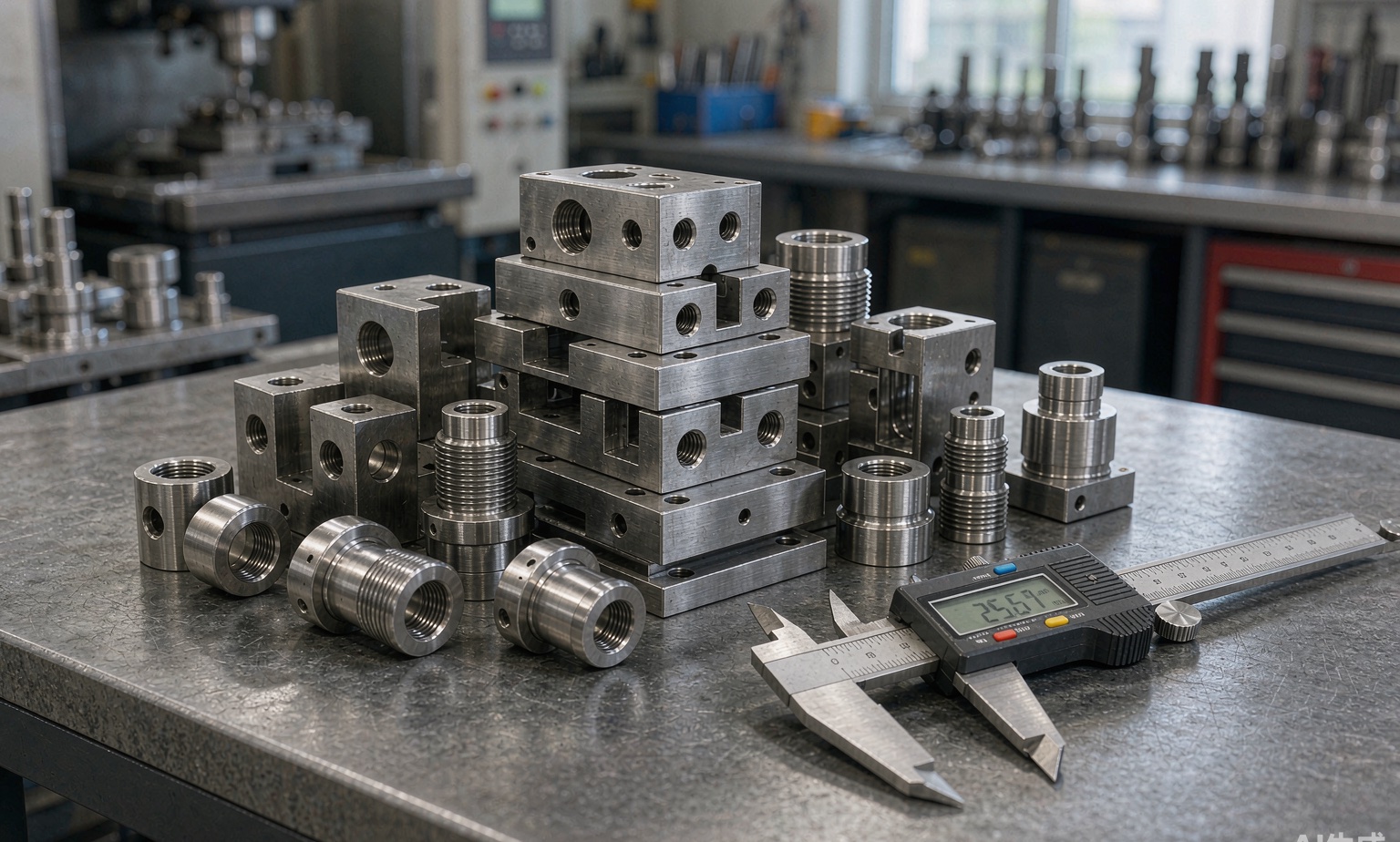
Stainless steel is not one material — and the three workhorse grades behave differently enough that picking the wrong one costs real money, either in machining time, in corrosion failures, or in an over-specified part that never needed 316 at all. This guide compares 303, 304 and 316 the way a machining supplier actually sees them: cutting behaviour, corrosion performance, and price impact.
303 machines fastest but should stay indoors; 304 is the default all-rounder; 316 adds molybdenum for chloride resistance at roughly a third more cost. If your part lives inside a machine, in an office, or in a dry enclosure, 303 or 304 is almost always correct. If it sees salt water, de-icing salt, food washdown or pharmaceutical chemicals, 316 earns its price.
303 is 304 with added sulphur (0.15% minimum). The sulphur forms soft inclusions that make chips break cleanly, pushing its machinability rating to about 78% of free-machining steel — the best of any austenitic stainless. In production this shows up as higher spindle speeds, longer insert life and reliable drilling without chip-packing, which is why screw-machine parts, fittings, shafts and instrument components default to 303.
The trade-off: sulphur inclusions pit the surface microscopically, so 303 has the lowest corrosion resistance of the three and is unsuitable for marine or chemical exposure. Its polished appearance is also slightly less mirror-bright.
304 (18% chromium, 8% nickel) is the most widely used stainless in the world — cutlery, sinks, architectural trim, food equipment. Corrosion resistance is good across most atmospheres and many chemicals; formability and weldability are excellent. Machinability is middling (~45–50%): austenitic grades work-harden rapidly, so cuts must stay aggressive and tools sharp, or the surface glazes and tools rub to death.
For machined parts, the rule of thumb: if 303's corrosion limits are comfortable, use it; if the drawing calls for "304 or equivalent" without a special environment, ask whether 303 passes the real duty — often it does, at a better price.
316 adds 2–3% molybdenum, which is what stops chloride attack: pitting in salt spray, crevice corrosion under gaskets, and corrosion in acidic process fluids. It is the standard for marine hardware, chemical plant, pharmaceutical and food processing lines, and it appears widely in medical device machining where instrument washdown cycles are brutal. Machinability is slightly worse than 304 and the molybdenum pushes raw material up meaningfully — which is why 316 on a dry indoor part is money wasted.
| Attribute | 303 | 304 | 316 |
|---|---|---|---|
| Machinability (austenitic SS) | Best (~78%) | Middle (~45%) | Lower (~40%) |
| Corrosion resistance | Moderate | Good | Best (chlorides) |
| Weldability | Poor–fair | Excellent | Excellent |
| Typical machined parts | Fittings, shafts, bushings | Brackets, housings, food equipment | Marine, chemical, medical, food-contact |
| Raw material vs 304 | ≈ +5–10% | baseline | ≈ +25–40% |
Material is only part of the story. On small turned parts, 303's machinability can save more in cycle time than its slightly higher stock price costs — a 10,000-piece fitting run in 303 often quotes 10–20% below 304 for the finished part. On large machined housings where material mass dominates, 304's cheaper stock wins. The full logic of how these trade-offs flow into quotations is in our cost factors guide.
We stock 303, 304/L and 316/L bar and plate in the common diameters and hold work in dedicated stainless cells to avoid carbon-steel cross-contamination. Turning, milling and 5-axis machining are all available in these grades, with passivation, pickling and electropolishing through our surface treatment services. Grade options and stock sizes are listed on the CNC machining steel page.
Essentially no — tensile and yield strengths are within a few percent. The sulphur addition affects machinability and corrosion, not meaningful strength.
Avoid it. Sulphur causes hot cracking in welds; if the part must be welded, use 304 and accept the slower machining.
For most machining, standard 316 is fine. Choose 316L when the part will be welded and sees corrosive service — the low carbon prevents sensitisation in the weld zone.
Usually no beyond passivation. Anodising doesn't apply to stainless; for extra surface performance we electropolish or apply PVD coatings — see Anodizing vs Powder Coating for how coatings differ on aluminium.
Unsure which grade your drawing really needs? Send it to sales@nbrjmetal.com with the working environment described — we will recommend the cheapest grade that survives the duty, and quote alternatives side by side.
Send your 2D/3D files and get a detailed quotation within 24 hours — DFM feedback, material and tolerance advice, and lead time included. Prototypes from 1 piece, no minimum order.
Request a Free Quote → WhatsApp Us
Or email jasonhardware@foxmail.com · Reply within 24 hours, Monday–Saturday
Contact: Mr Zhang
Phone: +86-18368240367
E-mail: jasonhardware@foxmail.com
Add: No.16 Laoshan Road, Beilun District, Ningbo City
LiveChatclose
 Send Email
 WhatsApp