






jasonhardware@foxmail.com+86-0574-58202256
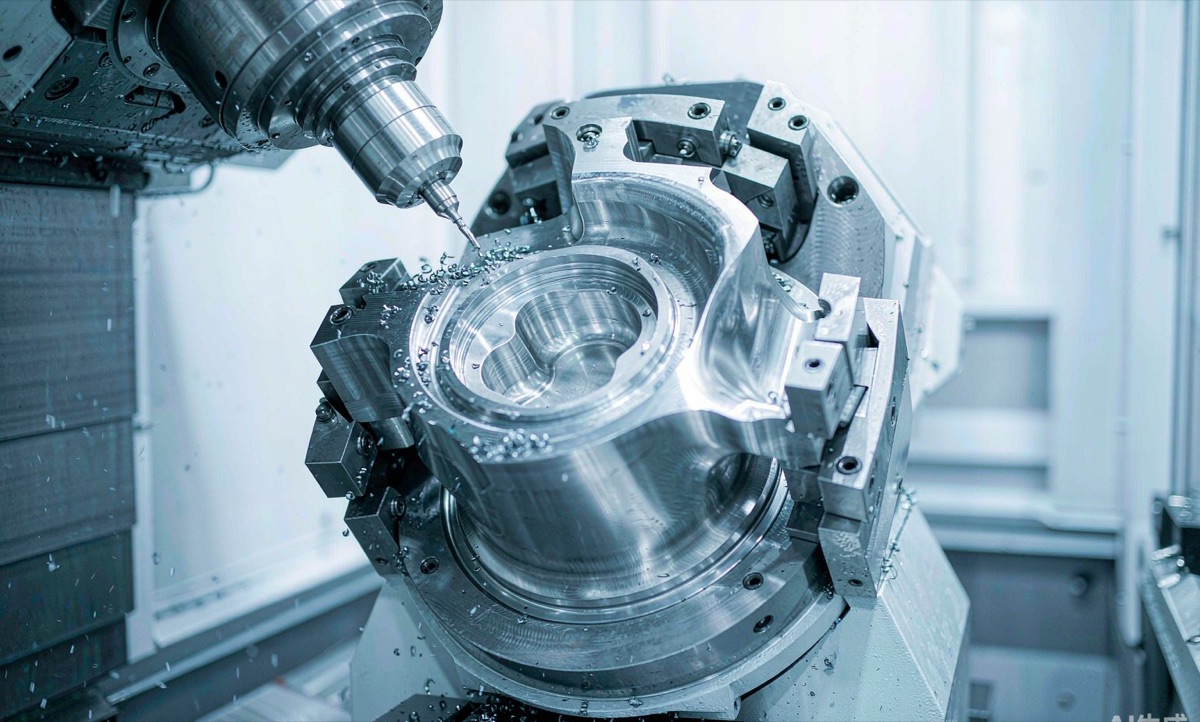
Five-axis machining has a reputation for being exotic and expensive. Sometimes it is. But for a surprising range of parts it is actually the cheaper route, because it removes setups rather than adding axes for their own sake. This guide explains what the extra rotations do, the difference between simultaneous and 3+2 machining, and how to tell whether your part needs them.
This overview comes from Ningbo Renjiu Machinery, where multi-axis and conventional machining run side by side — so the recommendation you get is based on the part, not on filling idle machines.
A three-axis milling machine moves the tool in X, Y and Z. The part is machined from one direction at a time, so every face that the spindle cannot reach requires a second setup — unclamp, turn over, re-indicate, hope the datum transfer costs you nothing.
A five-axis machine adds two rotations (A and B, or B and C depending on the layout). Two things become possible:
Most "five-axis" work in job shops is actually 3+2. True simultaneous motion earns its cost on parts with continuous 3D curvature.
| Factor | 3-axis | 3+2 positioning | Simultaneous 5-axis |
|---|---|---|---|
| Setups for a multi-face part | 2–4 or more | Usually 1–2 | 1 |
| Tool length needed | Long tools reach deep pockets | Shorter tools — the part tilts to meet them | Shortest — tool follows the surface |
| Datum error between setups | Accumulates per setup | Largely eliminated | Eliminated |
| Programming effort | Low | Moderate | High — needs skilled CAM work |
| Machine hour rate | Lowest | Medium | Highest |
| Sweet spot | Flat parts, 2.5D work, high volume of simple parts | Multi-face prismatic parts, angled features | Continuous curved surfaces, complex one-setup parts |
The premium machine rate has to be paid for by something. These are the cases where it pays for itself:
A good supplier tells you this before quoting. If every drawing you send comes back priced on the most advanced machine in the shop, ask what a three-axis route would cost.
No. The machine rate is higher, but one setup instead of three can bring the total price down. Quote both routes and compare — that is what we do.
It removes errors between setups, so relationships between features on different faces improve. Within a single face, a good three-axis machine holds the same numbers.
Yes. Send the drawing and we will price the sensible options side by side.
Aerospace and medical use it most, for curved surfaces and traceable single-setup work — see our pages on aerospace and medical machining.
Curious whether your part needs the extra axes? Send the model to our engineering team — we will tell you honestly which route is cheaper.
Send your 2D/3D files and get a detailed quotation within 24 hours — DFM feedback, material and tolerance advice, and lead time included. Prototypes from 1 piece, no minimum order.
Request a Free Quote → WhatsApp Us
Or email jasonhardware@foxmail.com · Reply within 24 hours, Monday–Saturday
Contact: Mr Zhang
Phone: +86-18368240367
E-mail: jasonhardware@foxmail.com
Add: No.16 Laoshan Road, Beilun District, Ningbo City
LiveChatclose
 Send Email
 WhatsApp