






jasonhardware@foxmail.com+86-0574-58202256
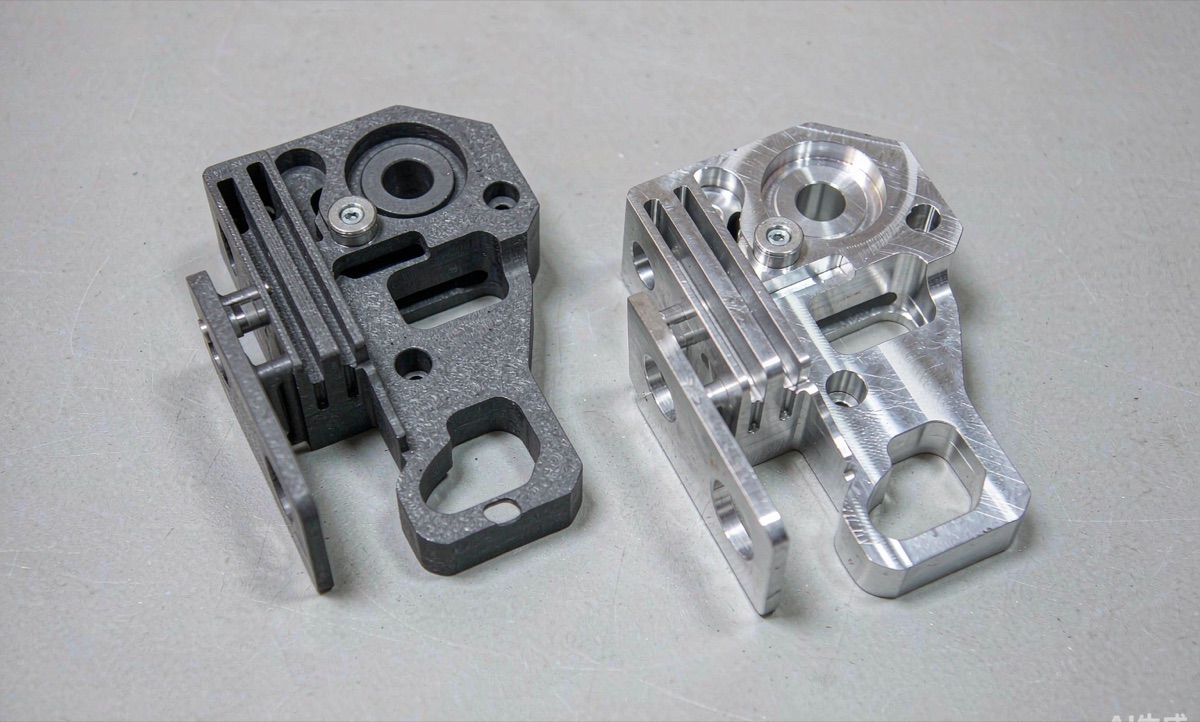
Every development project eventually asks the same question: should this part be printed or machined? The honest answer is that both processes have moved past the stage where one is "the future" and the other is "the past". They are simply different tools, and the parts themselves usually tell you which one they want.
At Ningbo Renjiu Machinery we run both — additive in-house, subtractive on the machining floor — so this comparison reflects what actually happens to real projects, not a preference for either technology.
3D printing builds a part layer by layer from nothing, guided by a model. Machining starts from a solid block and removes everything that is not the part. Almost every practical difference between the two flows from that one distinction.
| Factor | 3D Printing (SLA / SLS) | CNC Machining |
|---|---|---|
| Typical tolerance | ±0.1–0.2 mm | ±0.05 mm routine, ±0.01 mm precision |
| Surface finish | Layer lines or granular texture | Smooth as-machined, finishable to mirror |
| Materials | Resins, nylon, some filaments | Full metal and plastic catalogue, certified stock |
| Complexity penalty | Almost none | High — every feature costs toolpath time |
| One-off cost | Low | Moderate — setup dominates |
| Cost per part at volume | Flat — no economy of scale without batching | Falls sharply with volume |
| Lead time (one-off) | 1–3 days typical | 3–10 days typical |
| Strength consistency | Direction-dependent | Isotropic, predictable |
| Best volume | 1–100 parts | 1 part to hundreds of thousands |
In practice the two processes are not competitors; they are stages. A typical development path looks like this:
Skipping stage two is the classic mistake: a printed part passes tests that a machined part then fails, because the material and the process changed underneath the design.
For simple geometry, machining is often cheaper even for one piece, because printed part costs are driven by material volume. For a complex, lightweight design, printing usually wins. The crossover depends on the part — quoting both is the only reliable way to know.
Yes, and it is a common hybrid: print near-net geometry, then machine the critical faces, bores and threads. You get printing's freedom where it helps and machining's accuracy where it counts.
Generally yes under the same load path, mainly because of layer-direction weakness and porosity in some processes. SLS nylon is the strongest common option and is genuinely suitable for working parts.
Yes — see our 3D printing and CNC machining services, and the materials available for each.
Send us the part and the quantity — we will quote both routes and tell you plainly which one your part should take.
Send your 2D/3D files and get a detailed quotation within 24 hours — DFM feedback, material and tolerance advice, and lead time included. Prototypes from 1 piece, no minimum order.
Request a Free Quote → WhatsApp Us
Or email jasonhardware@foxmail.com · Reply within 24 hours, Monday–Saturday
Contact: Mr Zhang
Phone: +86-18368240367
E-mail: jasonhardware@foxmail.com
Add: No.16 Laoshan Road, Beilun District, Ningbo City
LiveChatclose
 Send Email
 WhatsApp