






jasonhardware@foxmail.com+86-0574-58202256
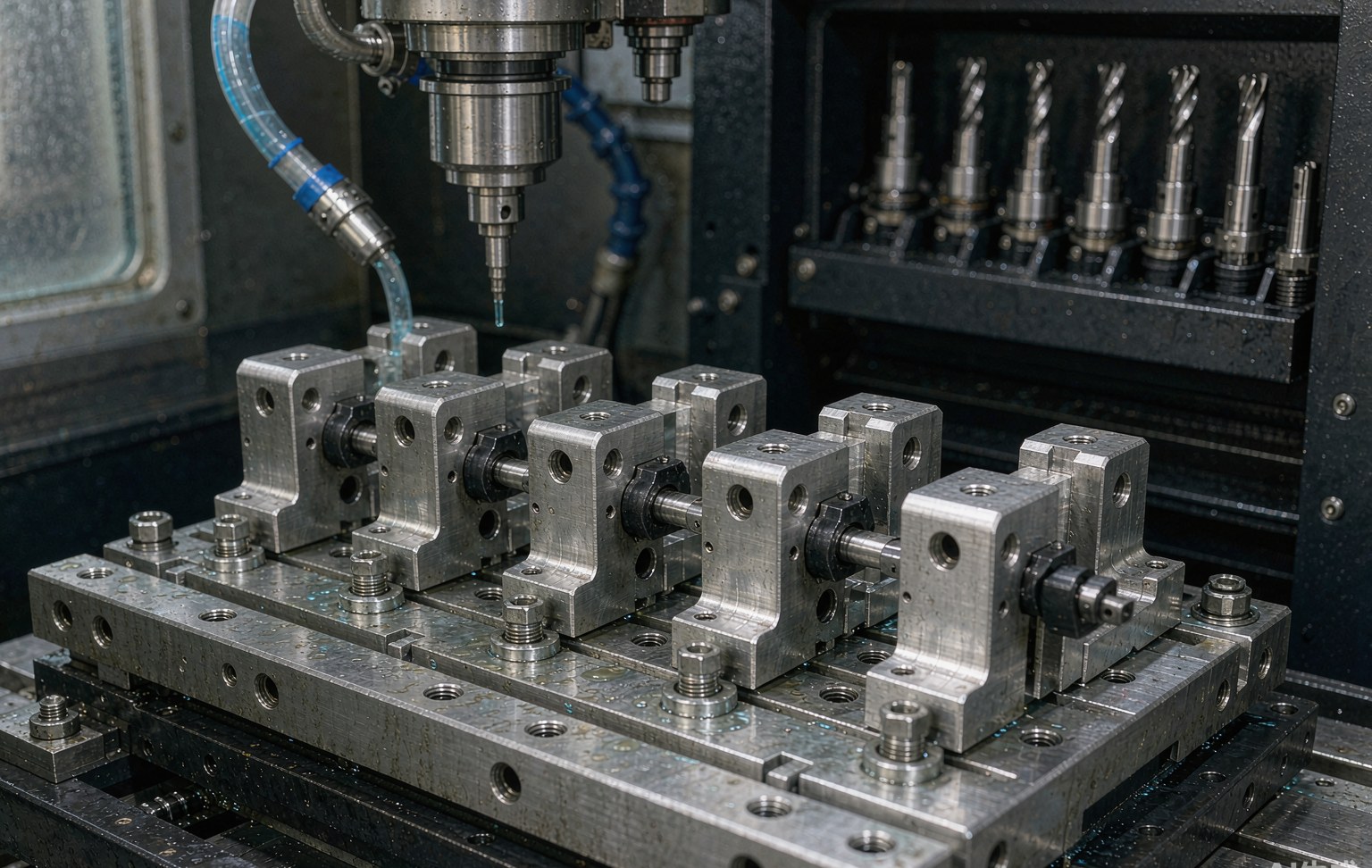
A buyer asks for 250 pieces of an aluminium housing and gets two quotes. Supplier A prices the part at $11.40 with a one-off "tooling: $850" line. Supplier B prices the same part at $12.60 with no tooling line at all. The naive comparison says B wins on the first order and A wins from piece 700 onward. The real answer is that the two quotes describe two different contracts — one where you own a fixture, and one where you never will — and the correct choice depends on questions that have nothing to do with the unit price.
That decision is what this article is about. We covered setup cost generally in a separate piece (why one part costs 10x more than a hundred); here we go one level deeper, into the fixture itself: what tooling actually is, the three ways suppliers charge for it, the arithmetic of fixture cost amortisation, and — the part buyers get wrong most often — who owns the fixture after it is built. These are the numbers we run internally at Ningbo Renjiu Machinery every time a quote needs dedicated workholding, and the decision rule at the end is the one we would use if we were buying the part instead of making it.
When a quotation says "tooling not included", the word covers a wider family of objects than most buyers assume. Some of them are true one-offs; others are consumables that get quietly rebuilt every order. Knowing which is which changes what you should be willing to pay for.
| Tooling item | Typical cost range | Reused on reorder? | Worth owning? |
|---|---|---|---|
| Machined soft jaws (lathe or mill) | $40–120 per set | Often re-cut each order | Rarely — it is closer to consumable setup material than an asset |
| Dedicated milling fixture, 3-axis part | $400–1,200 | Yes, for years | Yes above roughly 300–500 lifetime pieces |
| Hydraulic or pneumatic fixture | $1,500–5,000 | Yes | Only with a committed production programme |
| Vacuum fixture (thin-wall, plate parts) | $600–2,000 | Yes | Yes when distortion or marking is the constraint |
| Multi-part pallet / tombstone layout | $800–3,000 | Yes | Yes — usually the fastest payback of all |
| Form tools, custom drills, thread mills | $80–600 per tool | Consumed, re-bought | No — these are the supplier's cost of doing business |
| Checking fixture or go/no-go gauge | $300–1,500 | Yes | Yes on safety-critical or high-volume features |
Two lines in that table deserve emphasis. Soft jaws are the most commonly "charged" item and the least legitimately one: a serious shop treats re-cutting soft jaws as part of setup, the same way it treats rubbing down parallels. If a quote carries a $60 soft-jaw line, that is a shop telling you how it splits hairs, not a real asset transfer. Form tools, likewise, are consumed by cutting parts — a supplier who bills you for a worn-out form tool on reorder is billing you for their own production consumables.
The items worth arguing about are the true fixtures: the purpose-built plates, clamps, locators and pallets that exist only for your part number. Those are genuine assets with genuine resale and transfer value, and everything below is about them.
Every quotation with dedicated workholding in it resolves to one of three commercial structures. They are not interchangeable, and the difference matters more as quantity grows.
| Structure | How it appears on the quote | Who owns the fixture | Where it bites |
|---|---|---|---|
| One-off tooling charge | Separate line: "tooling / fixture: $X", billed with the first PO | You — if the PO says so | First order looks expensive; competitive quotes get harder to compare |
| Amortised into piece price | No tooling line; unit price is higher, or stepped down by quantity | Usually the supplier, unless stated otherwise | Reorders keep paying for a fixture that was paid off long ago |
| Supplier-owned "free tooling" | No line; supplier absorbs it as a customer-acquisition cost | Supplier, unambiguously | Leaving is expensive: a new supplier must rebuild it, or you pay for what you thought was free |
None of the three is a scam. Supplier-owned tooling is a legitimate pricing strategy — the supplier is betting on your repeat business and pricing the fixture as marketing. Amortisation is legitimate too, provided the schedule is written down. The failure mode is silence: a quote that does not say which structure it uses, so the buyer cannot see that the $1.20/pc premium on reorder is the $850 fixture being charged a fourth, fifth and sixth time.
This is the same audit discipline we described in reading a quotation line by line — lines that are missing are where the money hides. Tooling is simply the line that goes missing most often, because "no tooling charge" reads as good news on the first order.
Fixture cost amortisation is one division and one comparison. The supplier spends F on a fixture. The fixture saves s per part — through shorter load time, a thinner wall of stock, less scrap, or the ability to run six parts per cycle instead of one. The fixture pays for itself at N = F / s parts. Everything after part N is pure saving; everything before it is a subsidy you are paying one way or another.
Here is a real-shaped example, with numbers we would actually defend in a quote. A 6061-T6 sensor bracket, 130 × 90 × 12 mm, currently quoted at $9.80/pc in a standard vise, two setups, one part per cycle. A dedicated fixture at $850 lets us hold it on three sides, merge the two setups into one, and run four parts per cycle. The new quote is $7.40/pc.
| Order quantity | Buy without fixture: $9.80/pc | Buy with $850 fixture: $7.40/pc + fixture | Total at each price | Winner |
|---|---|---|---|---|
| 100 | $980.00 | $740 + $850 = $1,590.00 | $610 gap | No fixture, by $6.10/pc |
| 250 | $2,450.00 | $1,850 + $850 = $2,700.00 | $250 gap | No fixture, by $1.00/pc |
| 355 | $3,479.00 | $2,627 + $850 = $3,477.00 | break-even | Fixture pays for itself here |
| 500 | $4,900.00 | $3,700 + $850 = $4,550.00 | $350 saved | Fixture, $3.50/pc better |
| 1,000 | $9,800.00 | $7,400 + $850 = $8,250.00 | $1,550 saved | Fixture, $6.10/pc better |
| 2,500 | $24,500.00 | $18,500 + $850 = $19,350.00 | $5,150 saved | Fixture, $5,150 better on one programme |
Three observations fall out of that table, and they generalise:
Run your own numbers before accepting any tooling line; our free CNC machining cost calculator breaks the piece price into material, machining and setup so you can see what the fixture is actually buying.
Because the break-even hinges entirely on s, it is worth knowing the four honest sources of fixture savings — and the one dishonest one.
Load time. A part that takes 90 seconds to indicate, clamp and touch off in a vise takes perhaps 15 seconds to drop into a dedicated fixture with fixed locators. Across a 6-minute cycle that is a direct 20% capacity gain on the machine, which prices into the hourly rate calculation we described in what $40, $60 and $90 per hour actually buy.
Setup elimination. A two-setup part becomes a one-setup part when the fixture reaches the features a second op would have cut. You save the second setup and the tolerance stack between the two datums — which is sometimes the real reason to build the fixture, when the print has a true position called between features cut in different ops.
Multi-part cycles. Four parts per cycle divide the fixed elements of the cycle — tool approach, retract, tool changes — by four. On small brackets this is routinely the largest single saving and the reason a multi-part pallet pays back faster than any other tooling on the list above.
Scrap and rework. Repeatable location means the same datum every time: less variation in a critical dimension, fewer first-off rejections, less re-clamping damage on cosmetic surfaces. This saving is real but the hardest to promise in advance; treat supplier claims about it with friendly scepticism until the first-article report proves them.
The dishonest version is a fixture "saving" that is really just a quoting artefact — a supplier padding the non-fixture quote to make the fixture quote look generous. The defence is to ask for cycle time and load time on both routings, which a serious shop will state on the quote, as covered in our piece on why two suppliers quote the same part three times apart.
Here is the clause that matters more than any number in this article: if you paid for it, you own it, and it is transferable.
The scenario plays out the same way every time. You accept an $850 tooling charge on order one. Eighteen months later you need a second source — capacity, price, or simply risk. You discover that the quote you signed said nothing about ownership, the fixture lives in the supplier's tool crib with their asset tag on it, and your options are to pay them again to release it, pay a new shop to rebuild it from your drawing, or stay. None of those is a negotiation position; all three are a tax on the missing sentence in the PO.
The same logic, run in reverse, explains supplier-owned tooling. A shop that absorbs the fixture is not being generous — it is buying a switching cost, and on a part with $2,000 of dedicated workholding that switching cost is entirely rational. You do not need to refuse it. You need to know it is there, because it changes how hard you can push on price later: every dollar of supplier-owned fixture is a dollar of your volume they cannot afford to lose.
Amortised tooling sits in the middle and needs its own sentence: amortisation schedule and completion date in writing. "Tooling amortised" with no schedule means the $1.70/pc recovery never ends. Ask: over how many pieces, at what quantity step-downs, and does the price step down automatically when the schedule completes? Shops amortise cleanly every day — the ones who won't write down the schedule are the ones whose schedule you would not like.
Compress everything above into the rule we would apply as a buyer:
| Lifetime quantity forecast | What to accept | Sentence to put in the PO |
|---|---|---|
| Under ~200 pieces, single run | Refuse dedicated tooling; accept standard workholding and its price. If the supplier insists the part cannot be made without one, ask what the second-source design change is. | "No dedicated tooling; standard vise workholding." |
| 200–800 pieces, repeat programme | Pay the one-off, take ownership, and quote the transfer clause. Check the break-even division first — with the fixture cost and per-piece saving stated separately. | "Tooling $X billed once; tooling is buyer property, transferable on request, stored maintained and insured by supplier." |
| 800+ pieces or multi-year programme | Fixture plus palletisation, one-off or fast amortisation; ask for the multi-part layout proposal explicitly. | As above, plus: "Unit price steps down to $Y/pc after tooling recovery of N pieces on [date]." |
| Uncertain volume, testing the water | Accept supplier-owned tooling knowingly. Get the part, prove the design, and re-quote the tooling when volume is real. | "Tooling supplier-owned; buyer has right of first refusal to purchase at net book value." |
That last clause is the one almost nobody writes and everybody should: a right of first refusal on supplier-owned tooling costs nothing at signature and converts a hostage situation into a quotation when the relationship ends.
It means the supplier is recovering the fixture cost through the piece price instead of billing it up front. A $900 fixture amortised over the first 400 pieces adds $2.25 to each of those pieces and nothing to pieces 401 onward. Always ask for the schedule — the number of pieces over which recovery happens and the price after recovery — because without it, amortisation quietly becomes a permanent surcharge.
For a typical 3-axis milled part: $400–1,200 for a dedicated machined fixture, $40–120 for soft jaws (which are closer to a consumable), $1,500–5,000 for hydraulic or pneumatic work, $600–2,000 for vacuum fixtures on thin-wall parts, and $800–3,000 for a multi-part pallet. Quotes far below these ranges for genuinely dedicated workholding usually mean standard workholding with a different name on the line.
When lifetime quantity exceeds the break-even: fixture cost divided by per-piece saving. A $850 fixture saving $2.40 per part breaks even at 355 pieces. Below roughly 200 lifetime pieces, dedicated tooling rarely pays; above 800 it almost always does. The saving comes from shorter load time, eliminated second setups, multi-part cycles and lower scrap — ask for each of them quantified, not asserted.
If you are confident in the volume, pay it: the one-off is capped and you stop paying at break-even, while amortisation overruns are the supplier's upside and your cost. If volume is uncertain, amortisation or supplier-owned tooling shifts the risk to the party better placed to carry it — just get the schedule, or the ownership, in writing.
Whatever the PO says — and if the PO says nothing, the answer defaults to the supplier, because the fixture sits in their shop under their asset tag. One sentence fixes it: "Tooling is buyer property, transferable on request, stored and maintained by supplier at no charge." Ask for it on the first order, not the day you need a second source.
Quoting a part that needs dedicated workholding? Send us the drawing — we will price it with and without the fixture, show the break-even quantity in the quote, and put the ownership clause in writing on the first PO.
Send your 2D/3D files and get a detailed quotation within 24 hours — DFM feedback, material and tolerance advice, and lead time included. Prototypes from 1 piece, no minimum order.
Request a Free Quote → WhatsApp Us
Or email jasonhardware@foxmail.com · Reply within 24 hours, Monday–Saturday
Contact: Mr Zhang
Phone: +86-18368240367
E-mail: jasonhardware@foxmail.com
Add: No.16 Laoshan Road, Beilun District, Ningbo City
LiveChatclose
 Send Email
 WhatsApp