






jasonhardware@foxmail.com+86-0574-58202256
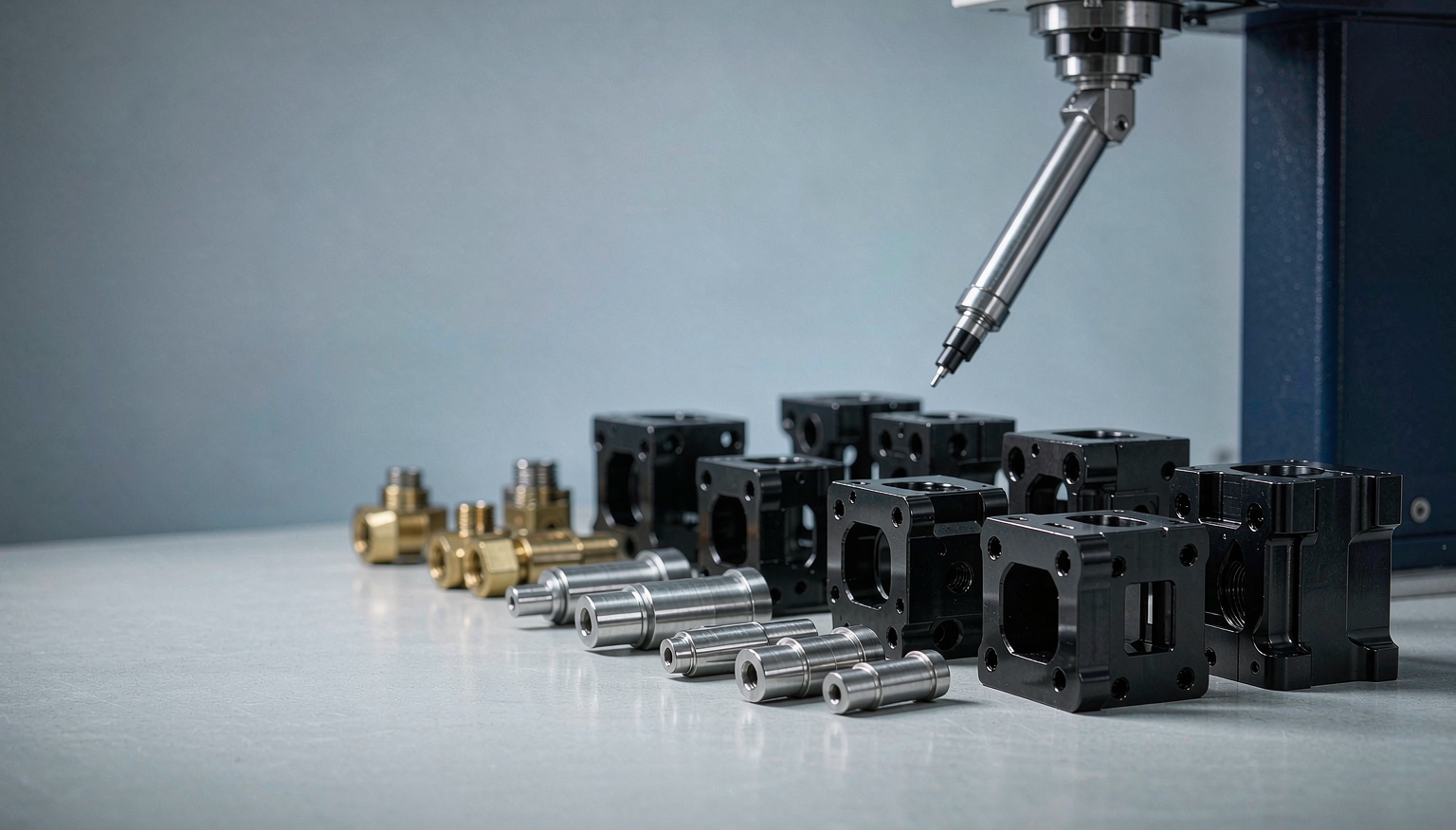
A 130 x 90 x 20 mm aluminium bracket. 200 pieces. Clear anodise. Two tolerances at plus/minus 0.05 mm, one face at Ra 1.6. Nothing exotic — we quote parts like this every week, and buyers send us the competing numbers every week too. The last set of three looked like this: $33.60, $14.80 and $9.80 per part. Same drawing. Same quantity. Same month.
A gap of that size does not come from one supplier being three times greedier than another. In our experience roughly 80% of the spread between competing CNC quotes is structural — different readings of the drawing, different quantity assumptions, different machines, different material buying, different amounts of risk baked into the number. Only the remainder is margin. This article takes that bracket apart line by line, shows where each dollar of the gap actually comes from, and gives you the arithmetic to normalise three quotes into one comparable figure before you decide.
At Ningbo Renjiu Machinery we see both sides of this: we are the second quote as often as the first, and buyers regularly forward us the "$9.80" they received elsewhere asking why we cannot match it. Here is the honest answer, with numbers.
The table below is the same part quoted by three different types of supplier, broken into the lines that actually drive the total. Supplier A is a domestic job shop in a high-cost country, quoting 3-axis work with three setups. Supplier B is a Ningbo factory with 4-axis capacity, running the part in two setups. Supplier C is a sourcing agent with no machine of its own, quoting from a partner shop's price list.
| Quote line | A · domestic job shop | B · Ningbo factory | C · sourcing agent |
|---|---|---|---|
| Material, blank weight | $5.76 (0.80 kg @ $7.20/kg) | $3.48 (0.80 kg @ $4.35/kg) | $3.15 (0.72 kg, 25 mm nominal stock) |
| Machining, cycle time | $18.42 (13 min @ $85/hr) | $6.30 (9 min @ $42/hr) | $4.00 (8 min @ $30/hr) |
| Setup, amortised over 200 | $1.49 (3.5 hr) | $0.53 (2.5 hr) | $0.30 (2 hr, assumed) |
| Anodising, clear | $3.20 (local small-lot line) | $1.60 (batch line) | $1.20 ("standard" thickness) |
| Inspection | $0.80 (FAIR + CMM sample) | $0.40 (FAIR + CMM sample) | $0.10 (visual only) |
| Packing | $0.35 | $0.25 | $0.15 |
| Subtotal | $30.02 | $12.56 | $8.90 |
| Margin and risk loading | +12% = $3.60 | +18% = $2.26 | +10% = $0.89 |
| Quoted unit price | $33.60 | $14.80 | $9.80 |
Read the machining line first, because it is the biggest single gap: $18.42 against $4.00. That is not a discount, it is a different production plan. Then read the material line: C's blank is 10% lighter than A's and B's, because C priced 25 mm nominal stock and never allowed for facing the part down to 20 mm. Two lines, and you already have most of the $23.80.
Every large spread we have investigated fell into one of five buckets. The table maps each reason to the size of gap it typically creates, the tell-tale line in the quotation, and the question that closes it.
| Reason | Typical spread | Where you see it | Question that closes the gap |
|---|---|---|---|
| 1. Different reading of the drawing | 10-40% | Vague tolerance or finish notes, "as drawn" disclaimers, no material cert listed | "Which tolerances are you holding, and what is your first-article process?" |
| 2. Different quantity basis | 5-25% | Setup inside or outside the unit price; price breaks at 100/500/1000 | "Is setup included at 200 pcs, and what is your price at 200 and 500?" |
| 3. Different routing and machine class | 20-60% | No mention of setups or machine type; unusually short lead time | "How many setups, and on what machine?" |
| 4. Different material buying strategy | 5-20% | Blank weight not stated; no MTR; nominal stock thickness | "What blank size are you buying, and is the MTR included?" |
| 5. Different risk loading | 8-30% | Margin hidden in the rate, payment terms, lead-time promises, currency | "What lead time is committed, and what happens on a rejected lot?" |
Notice that only reason 5 is about margin, and even there the loading is usually insurance rather than profit. The other four are engineering and purchasing decisions — which means they can be discussed, corrected, and re-quoted.
This is the most common and least visible cause. A drawing that reads "tolerance: general" or carries a title-block note like "unless otherwise stated +/-0.1" invites every supplier to pick their own interpretation. On the bracket above, three readings were in play:
Nothing about C's price is dishonest — it answers a different question. The same thing happens with surface finish: "Ra 1.6" on one face can mean a milled finish straight off a sharp insert, or a separate finishing pass that adds 2-3 minutes. It happens with anodising, where "clear anodise" spans a 5-25 micron range with very different cosmetic outcomes. And it happens with edge breaks: "deburr all edges" in one shop means a vibratory tumble, in another a hand touch-up, in a third a 0.3 mm chamfer on every edge.
Our guide to GD&T on machining drawings covers how to write those callouts so they cannot be read two ways. If you change nothing else after reading this article, change this: state the inspection level and the finish process on the RFQ, not just the number.
The second and third reasons are usually tangled together, because both show up as "the machining line looks too cheap".
Setup is the first trap. Some shops bury setup in the unit price; others quote it as a separate one-off line; a few quote it separately but only when the quantity is small. On 200 pieces a 3.5-hour setup at $85/hr is $1.49 per part — noticeable but not decisive. On 20 pieces the identical setup is $14.88 per part, which is why the same supplier can appear 40% more expensive at low volume and competitive at high volume. Our setup cost breakdown works through the amortisation maths; the practical rule is to always ask for the setup line separately so you can re-amortise it at your real quantity.
Routing is the bigger lever. The bracket can be made three ways:
A shop with spare 3-axis capacity will quote route one and discount the rate to win the job. A shop set up for 4-axis work will quote route two and look 30% cheaper on cycle time alone even at a higher nominal hourly rate. This is the mechanism behind the $18.42 versus $6.30 above — and it is exactly what our hourly rate guide explains: a low rate on the wrong machine is more expensive than a high rate on the right one.
Material. Three suppliers, three stock strategies. A buys 20 mm plate to nominal plus a facing allowance from a local distributor, with a mill test report. B buys from a stockholder in the same industrial park, in a thickness that lets two parts nest, and passes on a remnant price on part of the order. C prices 25 mm nominal stock and no facing allowance — 10% lighter blank, but the part arrives 5 mm oversize on one face unless somebody machines it, which is the $1.55 that reappears in the normalisation table further down.
The line to compare is not the material price but the implied utilisation: blank weight divided by finished weight. Our bracket keeps 0.52 kg of a 0.80 kg blank, so 65% — reasonable for a plate part. If a quote implies 3 kg of stock for a 0.5 kg part, the "cheap" material is not cheap. The full mechanics, including why 303 stainless is a more expensive metal that makes a cheaper part, are in material cost versus machining cost.
Risk loading. The last bucket is the one buyers misread most often. A quote is a promise with a price on it, and shops price promises differently:
This is why a 30% spread between a factory and an agent is normal and a 30% spread between two factories quoting the same routing, same quantity, same spec is a red flag worth investigating.
Quoted price is not comparable price. Add back the cost of everything the cheap quote left out and you get a number you can actually decide on. Here is the same three quotes, normalised:
| Normalisation step | A | B | C |
|---|---|---|---|
| Quoted unit price | $33.60 | $14.80 | $9.80 |
| + Freight and clearance to your door | $0.00 | $0.62 | $0.58 |
| + Machining the 5 mm facing allowance C omitted | $0.00 | $0.00 | $1.55 |
| + First-article report and CMM sample | $0.00 | $0.00 | $0.95 |
| + Anodise to the specified 15 micron class | $0.00 | $0.00 | $0.40 |
| Comparable landed cost per part | $33.60 | $15.42 | $12.75 |
| Total for 200 pieces | $6,720 | $3,084 | $2,550 |
Two things changed and one did not. C is still the cheapest, but its advantage over B fell from 34% to 17%. A is still three times B — but now you can see that $18 of that $18.80 gap is machine rate and labour cost in a high-cost country, not margin. That is a strategic choice about where you manufacture, not a negotiation.
The normalisation itself takes about ten minutes per quote. Add these five columns to a spreadsheet and fill them from the supplier's answers, not from assumptions:
If you want the arithmetic done for you, the free CNC machining cost calculator takes material, blank size, cycle time and quantity and returns the same breakdown — useful for sanity-checking a quote line you suspect is padded.
And here is the email we recommend sending to all three suppliers before you decide. It costs nothing and usually removes half the spread:
"Before we compare, could you confirm five points: (1) the blank size and stock thickness you are pricing, (2) how many setups and on what machine, (3) whether setup is included in the unit price at 200 pieces, (4) what inspection you include — first article report, CMM sample, or visual only, and (5) your price at 200 and at 500 pieces. We will re-quote on a like-for-like basis."
Normalised cost still is not total cost. Two adjustments decide the rest:
A simple decision table, from the hundreds of comparisons we have watched buyers make:
| Situation | Take the cheapest quote when… | Take the middle quote when… |
|---|---|---|
| Part is internal, non-cosmetic | Yes — rework is possible and cheap | Only if lead time is the binding constraint |
| Tolerance at or below plus/minus 0.05 mm | No | Yes — insist on the FAIR and CMM sample |
| First order with a new supplier | No — buy one lot as a trial, priced properly | Yes, with a paid sample run first |
| Visible anodised surface | No — cosmetic variance is the #1 rejection cause | Yes, after approving a sample |
| Repeat part, supplier already proven | Yes — the risk premium has been earned down | Compare on lead time only |
We cannot be the cheapest number in a three-quote comparison, and we do not try to be. What we can do is make our number comparable, which is why every quotation we send out of Ningbo states:
Send the drawing through our free quotation page and you will get that breakdown back, usually within one working day. If we think your drawing is being quoted three different ways by three suppliers, we will tell you which line is causing it — that conversation is more useful than a lower number.
Mostly because the quotes are not for the same thing. Machine rate and routing typically explain 20-60% of the gap, drawing interpretation 10-40%, quantity and setup assumptions 5-25%, material strategy 5-20%, and risk loading 8-30%. True margin differences between shops doing comparable work are usually under 10 points — everything above that is a difference in scope or production plan.
On machining hours, almost always — $40-60/hr against $80-120/hr. On total landed cost, usually but not always: freight, clearance, the 3-4 week transit and the cost of managing a distant supplier erode part of the gap, and at very low quantities setup plus freight can erase it entirely. Normalise on landed cost per part at your real quantity before concluding.
Yes, even when you intend to accept it bundled. A separate setup line tells you the amortisation basis and makes it possible to compare a 200-piece quote against a 500-piece quote from the same shop. On our bracket the setup is $1.49 per part at 200 pieces and $0.60 at 500 — a difference that is invisible if setup is hidden in the rate.
Three signals: the routing described is not physically capable of the tolerance, the inspection scope is "visual only" on a tolerance-critical part, or the lead time is shorter than the cycle time plus finishing implies. Any one of those means the price is missing scope rather than margin. The full pre-award checklist is in our RFQ and quote checklist.
Always, and most will. Send the five-point confirmation email above to every supplier in the comparison, then re-normalise. In our experience about a third of large spreads disappear at this stage because one supplier was quoting a different quantity break, a different stock thickness or a different inspection level without saying so.
Comparing three quotes and not sure which gap is real? Send us the drawing and the numbers you have — we will tell you which line is causing the spread, even if the answer is that another supplier is right for the job.
Send your 2D/3D files and get a detailed quotation within 24 hours — DFM feedback, material and tolerance advice, and lead time included. Prototypes from 1 piece, no minimum order.
Request a Free Quote → WhatsApp Us
Or email jasonhardware@foxmail.com · Reply within 24 hours, Monday–Saturday
Contact: Mr Zhang
Phone: +86-18368240367
E-mail: jasonhardware@foxmail.com
Add: No.16 Laoshan Road, Beilun District, Ningbo City
LiveChatclose
 Send Email
 WhatsApp