






jasonhardware@foxmail.com+86-0574-58202256
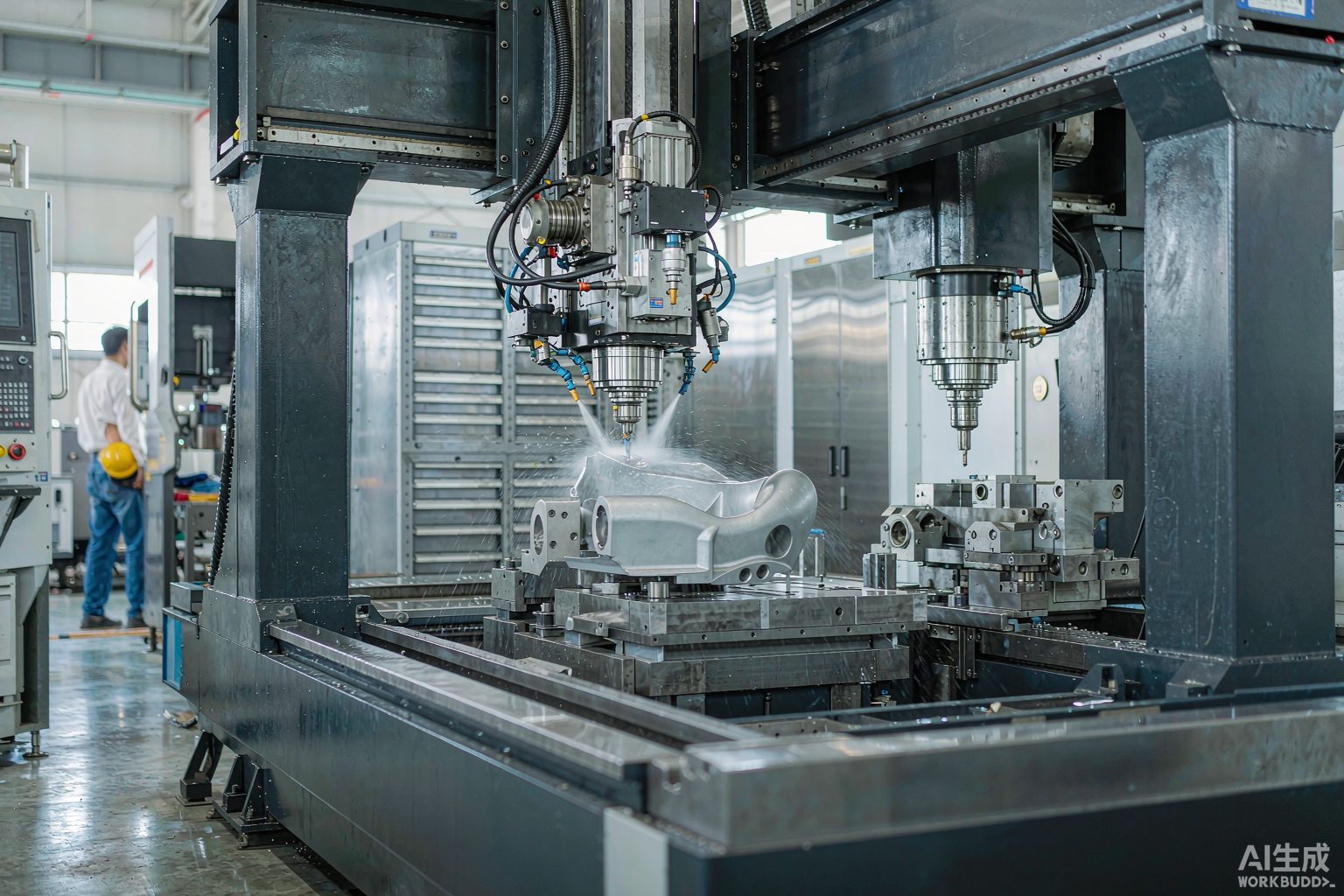
Ask three machine shops what they charge per hour and you will get three different numbers — sometimes spread across a 3x range. One shop says $40, another $60, a third wants $90 or more. Buyers who treat these numbers as pure markup are reading them wrong. The CNC machining hourly rate is the price of a bundle of capabilities, and knowing what each rate tier actually buys is the fastest way to sanity-check any quote before you sign it.
At Ningbo Renjiu Machinery we run 3-, 4- and 5-axis mills and turning centres every day, and we see quotes from all over the world when buyers compare us against local suppliers. This guide unpacks what a machine shop hourly rate really contains, what each rate band delivers, how rates differ by machine class and region, and how to use a rate to reverse-engineer a quote — with worked numbers you can copy for your own parts.
If you want the full picture of how a per-part price is built up from machine time, material and quality overhead, read our companion guide on CNC machining cost factors. This article zooms into just one of those factors: the clock.
A shop's hourly rate is not the wage of the operator. It is a fully loaded number designed to recover every cost the shop incurs while that spindle is turning, plus a margin. A typical loaded rate bundles:
What the rate usually does not include: raw material, outside services (anodising, plating, heat treatment), inbound freight, and one-time costs like programming and fixture building. Those appear as separate lines on a serious quotation. If a quote shows only "machine time × rate", ask what the other lines are — the honest shops can always break it down.
Hourly rates cluster into bands that correspond to machine class, region and service level. The table below is what those three headline numbers typically buy in practice:
| Rate band | Typical machine | Typical location & shop type | What you actually get | Watch out for |
|---|---|---|---|---|
| ~$40/hr | 3-axis VMC, CNC lathe, 2-4 years old or fully depreciated | China, India, SE Asia — mid-size job shop | Standard aluminium and steel parts, ±0.05–0.1 mm work, simple 2D parts in volume | Thin engineering support; assumptions on tolerance and finish may be loose |
| ~$60/hr | Recent 3/4-axis mills, mill-turn centres | China (quality-focused), Eastern Europe, US high-mix job shops | Tighter tolerances (±0.01–0.02 mm achievable), multi-setup parts, active DFM feedback, in-process inspection | Setup counts still matter; four setups can erase the rate advantage |
| ~$90+/hr | 5-axis machining centres, Swiss-type lathes, jig grinders | US, Western Europe, Japan; or specialist cells anywhere | Complex geometry in one setup, hard metals (titanium, Inconel), certified industries (AS9100, ISO 13485), full documentation | You are also paying for local overhead — check whether the geometry really needs it |
The key insight: a $90 shop is not a rip-off, and a $40 shop is not automatically a bargain. The $90 rate buys capabilities the $40 rate physically cannot deliver — and if your part does not need them, you are overpaying by definition. Conversely, if a $40 quote covers a part with five-axis geometry, someone has miscalculated, and the difference will surface as a rejected batch.
Within one shop, rates step up sharply by machine class. Indicative loaded rates at a quality-focused Chinese shop (our region) look like this:
| Machine class | Indicative rate (China, loaded) | Equivalent US/EU shop rate | What it is for |
|---|---|---|---|
| CNC turning (gang-tool) | $25–40/hr | $60–90/hr | Small round parts, bushings, fittings in volume |
| 3-axis VMC | $35–50/hr | $75–110/hr | Brackets, housings, plates — the workhorse of job shops |
| 4-axis VMC (rotary) | $45–60/hr | $90–130/hr | Parts needing features on 2–3 faces without re-fixture |
| 5-axis machining centre | $60–90/hr | $120–180/hr | Prismatic complexity in one setup, impellers, aerospace structure |
| Swiss-type turning | $40–65/hr | $85–140/hr | Long, small-diameter parts with medical-level finish |
| Surface / jig grinding | $50–80/hr | $100–160/hr | Flatness and finish beyond what milling delivers |
Two lessons follow. First, matching the part to the cheapest machine class that can hold the tolerance is worth more than negotiating the rate itself. A part quoted on a 5-axis when a 4-axis would do is quietly 30–50% overpriced on every line. Second, the regional gap is real and persistent — roughly 2–2.5x between a Chinese shop and a US/EU shop at the same machine class — which is why cross-border sourcing of machined parts has not gone away, despite freight and tariff noise. For a deeper comparison of suppliers, see our guide on choosing a CNC machining supplier in China.
Here is the arithmetic that makes rate tiers concrete. Take a mid-complexity 6061-T6 aluminium housing:
Now price it at the three rate tiers (machining time includes a 15% allowance for loading and chip clearance, so 48.3 billable minutes = 0.805 hr):
| Cost line | $40/hr shop | $60/hr shop | $90/hr shop |
|---|---|---|---|
| Machining (0.805 hr) | $32.20 | $48.30 | $72.45 |
| Material | $11.50 | $11.50 | $11.50 |
| Programming + fixture (amortised /100) | $1.80 | $1.80 | $1.80 |
| Anodising | $1.20 | $1.20 | $1.20 |
| Inspection | $0.90 | $0.90 | $0.90 |
| Margin (12%) | $5.71 | $7.64 | $10.54 |
| Unit price | $53.31 | $71.34 | $98.39 |
Three observations that hold up across hundreds of real quotes:
Buyers fixate on the rate because it is the only number that looks comparable across quotes. But total landed cost is what you actually pay. A higher rate routinely wins in four situations:
The reverse is also true: when a part is geometrically simple, tolerance is ±0.1 mm, material is aluminium and the batch is 500+, a $40-rate shop in a low-cost region is usually the economically correct answer — and quoting it at a $90 local shop is money spent on capability you do not use.
Our RFQ checklist covers the exact questions to send with a drawing so quotes come back comparable the first time.
You do not need a supplier to get a rough cost. Three steps, five minutes:
For a faster version of this, use our free CNC machining cost calculator — it walks through material, machine time and quantity breaks and returns an indicative price range before you send anything to a supplier.
We quote from CAM-verified cycle times, with the rate shown by machine class so you can see what you are buying. A typical Renjiu quotation states:
If a drawing can be made cheaper on a different machine class or with a design change, we say so in the quote — a repeat buyer who trusts the numbers is worth more than one overpriced order. Start with our free quotation and a DFM note on your drawing.
Loaded shop rates cluster around $35–50/hr for 3-axis work in China, $50–65/hr for 4-axis and mill-turn, and $60–90/hr for 5-axis. In the US and Western Europe the same machine classes run roughly 2–2.5x higher. Swiss turning and grinding sit between the milling bands.
Different capital cost, different overhead, different region — and different definitions. Some shops bundle inspection and programming into the rate; others bill them separately. Before comparing, normalise the quotes to the same assumption set: quantity, tolerance, finish and documentation. Our guide to what determines machined part prices shows the full breakdown.
No. You pay machine time for cutting and loading hours only. Queue time, transport between departments and waiting for outside services are covered by the shop's scheduling, not billed to you — which is one more reason lead time and price are separate negotiations.
Rate discounts of 5–15% are realistic for predictable repeat volume, flexible delivery windows, or orders that fill a shop's quiet capacity. Negotiating below that on a one-off order usually just moves the cost somewhere else — into looser inspection or a longer lead time.
Not inherently — a low-rate region can hold tolerances perfectly well. The risk is mismatch: a rate that low usually means older machines or thin engineering support, which matters enormously on a ±0.01 mm titanium part and not at all on a ±0.1 mm aluminium bracket. Match the rate band to the difficulty of the part, not to your budget.
Want to know what your part should cost at each rate tier? Send us the drawing and we will return a machine-class breakdown with the quote — including the cheaper option if we see one.
Send your 2D/3D files and get a detailed quotation within 24 hours — DFM feedback, material and tolerance advice, and lead time included. Prototypes from 1 piece, no minimum order.
Request a Free Quote → WhatsApp Us
Or email jasonhardware@foxmail.com · Reply within 24 hours, Monday–Saturday
Contact: Mr Zhang
Phone: +86-18368240367
E-mail: jasonhardware@foxmail.com
Add: No.16 Laoshan Road, Beilun District, Ningbo City
LiveChatclose
 Send Email
 WhatsApp