






jasonhardware@foxmail.com+86-0574-58202256
Titanium has a reputation: incredible performance, difficult to machine, expensive. All three are half-true. What actually matters is choosing between the two common grades — commercially pure Grade 2 and Grade 5 (Ti-6Al-4V) — because they serve completely different duties, and machining economics swing heavily on which one the drawing specifies. This guide compares them from a CNC shop's perspective.
| Property | Grade 2 (CP titanium) | Grade 5 (Ti-6Al-4V) |
|---|---|---|
| Composition | ≥99% commercially pure | 6% Al, 4% V alloy |
| Tensile strength | ~345–485 MPa | ~900–1000 MPa |
| Density | 4.51 g/cm³ | 4.43 g/cm³ |
| Machinability | Moderate (easier) | Hard (≈30% of steel's machinability) |
| Weldability | Excellent | Good (inert atmosphere) |
| Typical use | Chemical plant, housings, medical shells | Aerospace structure, implants, motorsport |
The density column hides titanium's real superpower: both grades weigh about 60% of aluminium per the same volume, but Grade 5 carries roughly double the strength of common aerospace aluminium — the specific strength that makes it the default where every gram matters.
Grade 2's value is corrosion resistance plus formability, not strength. It outperforms most stainless in seawater, chlorides and oxidising acids, and it welds and cold-forms readily. Typical machined parts: chemical-processing vessel internals, heat-exchanger shells, caustic and seawater pump components, jewellery, and medical equipment housings where the implant-level strength of Grade 5 isn't needed.
Because it is pure and softer, Grade 2 also machines noticeably friendlier: chips still risk galling (like pure copper), but with sharp tooling and good coolant it behaves closer to a stubborn stainless than to a superalloy. Costs run meaningfully below Grade 5 for both stock and machining time.
Grade 5 is the aerospace alloy — roughly half of all titanium melted worldwide. With double the strength of Grade 2, excellent fatigue performance and service temperatures to about 400 °C, it is the default for structural brackets, airframe fittings, fasteners, high-end bicycle and automotive parts, and load-bearing medical implants. If the part carries load and the spec sheet says "titanium", it almost always means Grade 5.
The price of that strength is machining difficulty. Grade 5's low thermal conductivity means heat concentrates at the cutting edge instead of flowing into the chip; combined with titanium's chemical affinity for cutting tools at high temperature, tool life collapses if speeds are copied from steel practice. The practical rules we machine by:
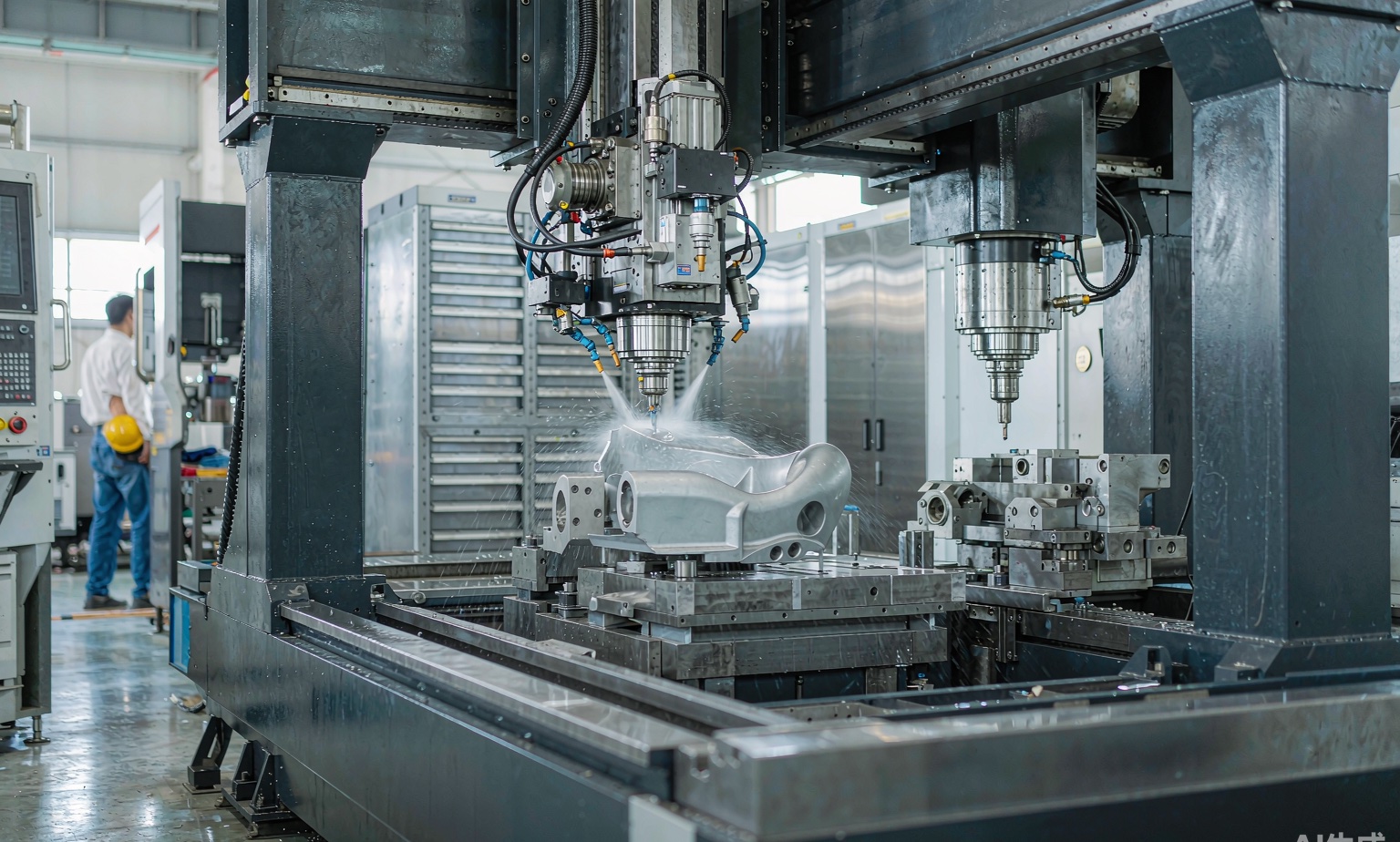
Complex aerospace geometry with deep pockets and thin walls is where 5-axis machining pays for itself: shorter tools, one setup, and better heat distribution across the cutting edges.
Honest budgeting: Grade 5 stock costs several times 304 stainless per kilo, material removal rates run a third to half of steel, and tool consumption is higher — a realistic finished-part premium over stainless is commonly 3–6× for small structural parts. The counterweight is design: titanium parts often replace steel parts at 60% of the weight and need less material by volume, and they outlast the product around them. Where the duty is merely corrosive rather than structural, Grade 2 typically lands at a 1.5–2.5× premium over stainless, which is far easier to justify. Our cost factors guide explains how we build these numbers into quotes.
Titanium parts rarely fail from machining alone — they fail from missing verification. For load-bearing work we provide material certs traceable to the melt, hardness and conductivity checks where specified, and full dimensional reports per our quality control process. Surface treatments are limited but important: anodising (Type II colour) for identification, or coatings per our finish comparison — always with the note that titanium's oxide layer is already its best protection.
Per volume, no — high-strength steels beat Grade 5 on absolute strength. Per gram, yes: Grade 5's specific strength exceeds most steels, which is the whole point in moving structures.
Low thermal conductivity (heat stays at the edge), chemical reactivity with tool materials at temperature, and springy low-modulus behaviour. All are manageable with the parameters above — the cost is planning, not possibility.
Yes, via electrochemical oxide-thickness anodising — the colour is interference in the oxide film, not dye. It is popular for both part identification and cosmetics.
Grade 2 unless the walls must be structural: it resists crevice corrosion marginally better, machines faster, and costs less. We quote both when the duty is ambiguous.
Titanium project on the bench? Send the STEP file to sales@nbrjmetal.com — we will advise grade, flag wall thicknesses and radii for machinability, and quote both grades where the choice is open.
Send your 2D/3D files and get a detailed quotation within 24 hours — DFM feedback, material and tolerance advice, and lead time included. Prototypes from 1 piece, no minimum order.
Request a Free Quote → WhatsApp Us
Or email jasonhardware@foxmail.com · Reply within 24 hours, Monday–Saturday
Contact: Mr Zhang
Phone: +86-18368240367
E-mail: jasonhardware@foxmail.com
Add: No.16 Laoshan Road, Beilun District, Ningbo City
LiveChatclose
 Send Email
 WhatsApp