






jasonhardware@foxmail.com+86-0574-58202256
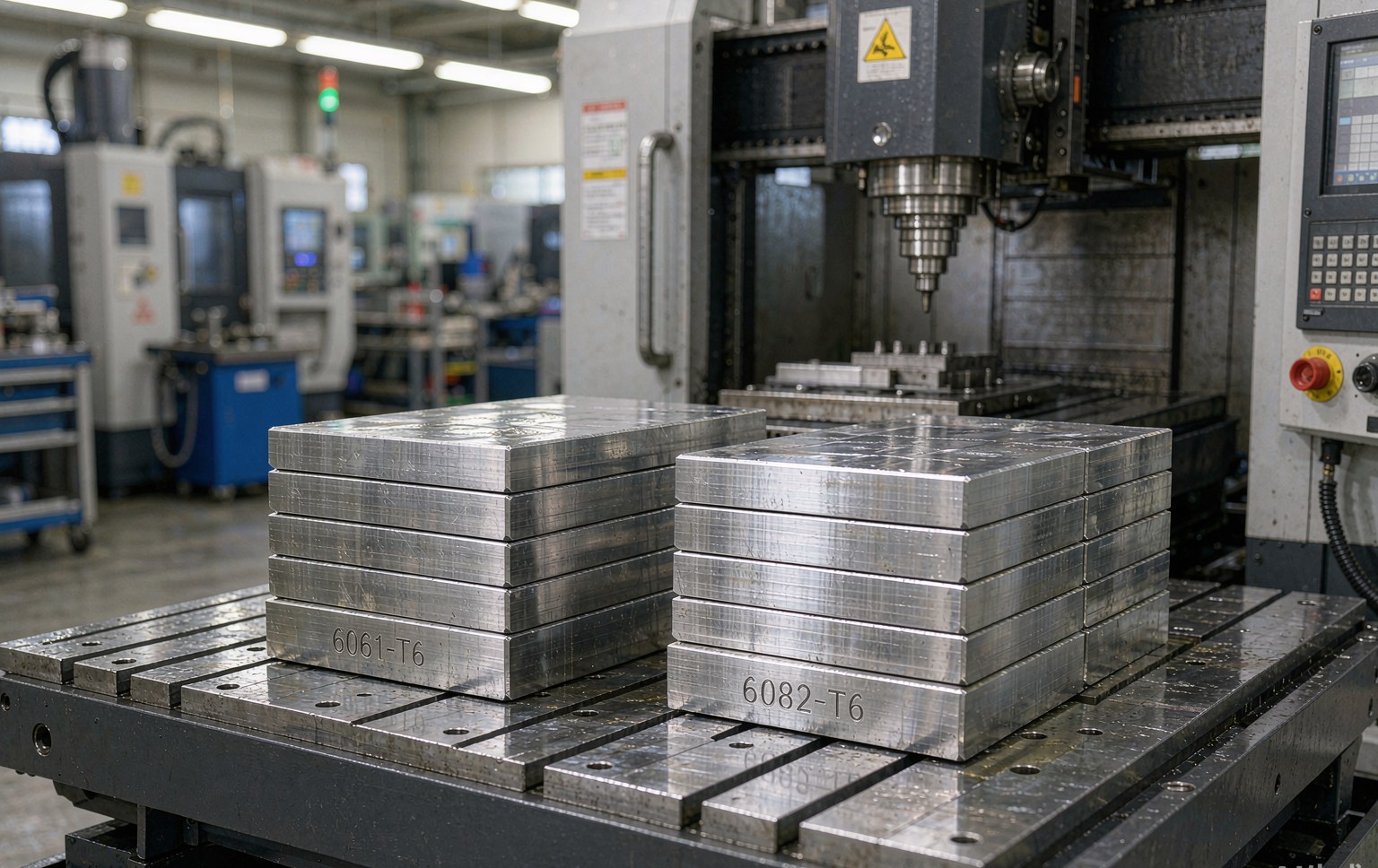
Ask three machine shops whether 6061-T6 or 6082-T6 is the "right" aluminium, and you will get three confident answers — usually the one that matches whatever bar stock is on their shelf. The truth is more useful: these two alloys are chemically close cousins, mechanically within 10% of each other, and interchangeable in a large share of real parts. But they are not identical, and the differences that do exist — stock availability, standard systems, anodising response, minimum strength on paper — are exactly the kind of thing that turns into a spec dispute at incoming inspection if nobody looked early.
This guide is a deep, head-to-head comparison of the two alloys for CNC-machined parts specifically: chemistry and what it does, real mechanical data, machinability and cutting parameters, anodising behaviour, regional availability, and a worked cost example. If you want the broader survey across 5052 and 2024 as well, start with our aluminium alloy selection guide; this page goes deeper on just the 6xxx pair.
6061 and 6082 are both Al-Mg-Si alloys, heat-treatable to the T6 temper through the same mechanism: magnesium and silicon combine into Mg₂Si precipitates that block dislocations and raise strength. The practical difference starts with geography and standards, not metallurgy.
That single fact drives more real-world decisions than any property table: if your drawing comes from a European OEM, it says 6082 because that is what their extruder supplies — and if your machining partner is in Asia, 6061 plate is on the shelf today while 6082 plate may need to be ordered in. Both directions of substitution are usually acceptable; we will cover exactly when they are not.
The compositional differences are small but deliberate:
| Element | 6061 (wt %) | 6082 (wt %) | Effect of the difference |
|---|---|---|---|
| Silicon | 0.40–0.8 | 0.7–1.3 | More Si → more Mg₂Si precipitate → slightly higher strength in 6082 |
| Magnesium | 0.8–1.2 | 0.6–1.2 | Broadly equivalent; Mg is the other half of the strengthening pair |
| Manganese | 0.15 max | 0.40–1.0 | Mn in 6082 controls grain structure in extrusion; trace amounts can slightly influence anodising tone |
| Copper | 0.15–0.40 | 0.10 max | Less Cu in 6082 → marginally better corrosion resistance, slightly lower machinability "crispness" |
| Chromium | 0.04–0.35 | 0.05–0.25 (often low) | Cr refines grain; both are fine-grained in practice |
| Iron (max) | 0.7 | 0.5 | Lower Fe in 6082 can help cosmetic anodising uniformity |
Read that table and you can predict everything that follows: 6082 trades a touch of machinability and cosmetic consistency for a few percent more strength and slightly better corrosion behaviour. Nothing dramatic — but enough to matter when a drawing specifies minimum values.
Typical values for the T6 temper, drawn from Aluminium Association and EN 755-2 data. Note that extrusion minimums vary with section thickness; the numbers below are typical for common bar and plate sizes.
| Property | 6061-T6 | 6082-T6 | Practical meaning |
|---|---|---|---|
| Ultimate tensile strength | ~310 MPa | ~340 MPa | 6082 carries ~10% more load before failure |
| Yield strength (0.2%) | ~276 MPa | ~290–320 MPa | Both stay elastic far above most bracket loads |
| Elongation | ~12% | ~10–11% | Both have useful ductility; 6061 slightly more forgiving |
| Hardness | ~95 HB | ~95–100 HB | Functionally identical for wear decisions |
| Fatigue endurance (5×10⁸ cycles) | ~96 MPa | ~100–110 MPa | 6082 slightly better, but design governs, not alloy |
| Density | 2.70 g/cm³ | 2.70 g/cm³ | Identical — no weight difference |
| Thermal conductivity | ~167 W/m·K | ~160–180 W/m·K (varies by product form) | Both excellent for heat sinks and manifolds |
| Continuous service temp. | ~150 °C | ~150 °C | Neither is a high-temperature alloy; over-temp softens the temper |
The honest summary: on properties alone, you cannot justify a cost premium either way for a typical machined bracket, housing, plate or manifold. The strength delta is real but small; no design that is marginal in 6061 suddenly becomes robust in 6082. Where the alloys genuinely separate is availability, certification and finish — the next three sections.
Both alloys machine excellently by any standard — they sit near the top of the aluminium machinability ranking, well above gummy 5xxx grades and far above forged steels. There is a small, repeatable difference that machinists notice:
For a 12 mm solid-carbide 3-flute endmill in a rigid CNC milling machine, typical starting parameters look like this:
| Parameter | 6061-T6 | 6082-T6 |
|---|---|---|
| Cutting speed (Vc) | 450–650 m/min | 400–600 m/min |
| Spindle speed (Ø12 mm) | ~12,000–17,000 rpm | ~11,000–16,000 rpm |
| Feed per tooth (fz) | 0.09–0.16 mm | 0.08–0.15 mm |
| Axial depth (roughing) | up to 1.5–2 × D | up to 1.5 × D |
| Coolant | flood or MQL | flood preferred (chip evacuation) |
| Expected tool life index | 100 (reference) | ~90–95 |
Two machining notes worth more than the parameter table:
Both alloys take Type II (decorative) and Type III (hard) anodising well — this is a core strength of the 6xxx family. But if your part is cosmetic, there is a nuance worth knowing:
Two further anodising rules that apply to both alloys: machined surfaces and saw-cut faces can anodise to slightly different tones on the same part (buy surfaces pre-machined if cosmetic uniformity matters), and hard anodising grows the layer both ways — a Type III spec of 50 µm adds roughly 25 µm to every dimension, which must be accounted in tolerance stacking. If anodising cost is part of your quote review, our guide on reading a quotation line by line shows where finishing sits on the quote and what drives its price.
Both alloys have good general atmospheric corrosion resistance — far better than 2024, below 5xxx marine grades. For outdoor or humid service, both should be anodised, chromate-conversion coated (Alodine/chem-film) or painted. Neither is the right choice for continuous salt-water immersion; that is 5052/5083 territory.
Welding: both weld well with 4043 or 5356 filler (TIG/MIG), and both lose roughly 30–40% of their strength in the heat-affected zone — which post-weld T6 re-treatment almost never recovers economically. Weld them for structural adequacy, not for full base-metal strength, and tell your welder which alloy the filler must match. 6082's near-zero copper marginally reduces hot-crack sensitivity, but in practice the weld procedures are identical.
On paper the two alloys cost about the same — typically within 2–5% of each other per kilogram for equivalent product forms. What actually drives your landed cost is where your supplier's stock is:
Worked example — a 120 × 80 × 25 mm hydraulic manifold block, 12 pieces, machined all over from plate:
The machine time is the same for both alloys to within a few percent, so at 12 pieces the material delta is a rounding error — but the lead-time delta is real. If your European drawing says 6082 and the schedule is tight, ask your supplier early whether 6082 stock exists or whether a 6061 substitution with a deviation note is acceptable. If you are modelling the total cost yourself, run the numbers through our free CNC machining cost calculator, and see how material choice interacts with machining time in our material cost vs machining cost breakdown.
| Situation | Choose | Why |
|---|---|---|
| Drawing from a European OEM says EN AW-6082 | 6082-T6 | Match the spec; substitution needs a signed deviation |
| Drawing says 6061-T6 / ASTM B209 | 6061-T6 | Match the spec; 6082 also passes, but why argue with inspection |
| US/Asia supplier, general bracket/housing, no spec | 6061-T6 | Shelf stock, best cosmetic anodising, lowest lead time |
| Structural extrusion or thick sections in Europe | 6082-T6 | Native European structural alloy, highest minimum strength |
| Cosmetic anodised consumer part | 6061-T6 | Most consistent anodising tone lot-to-lot |
| Maximum strength per gram in aluminium | Neither — 7075-T6 | ~570 MPa, at higher cost and poorer corrosion behaviour |
| Salt-water immersion or formed sheet | Neither — 5052/5083 | Marine-grade corrosion and forming, poor machinability |
| Heavy asymmetric machining from plate | Either, in T651 | Stress relief matters more than the alloy number |
If strength is pushing you beyond the 6xxx family, read our comparison of 6061 vs 7075 before you pay the premium — many "7075 required" drawings are really fatigue or stiffness questions that a geometry change solves cheaper. And for how any of these alloys behave against stainless in load and environment, see our stainless steel grade comparison.
Because the alloys are so close, substitutions happen constantly in cross-regional supply. The rules we follow:
The most expensive failure mode in this family is not a part breaking — it is an incoming-inspection rejection because the certificate does not match the drawing. One email before machining costs nothing; a rejected batch costs the whole run.
For the large majority of CNC-machined parts, yes — mechanical properties are within about 10%, corrosion behaviour is equivalent, and machining is effectively identical. Check three things before swapping: minimum strength values on the drawing, the standard system (ASTM vs EN) your inspection requires, and whether the part is cosmetic-anodised. If all three are clear, the substitution is safe when documented.
List prices per kilogram are within a few percent. The real cost difference comes from stock availability in your supplier's region: 6061 is shelf stock in Asia and North America, 6082 in Europe. Buying the non-native grade usually means a longer material lead time and sometimes a small-lot premium — which on a 12-piece order outweighs any alloy price difference.
6061 gives the most consistent, clear anodised finish and is the default for visible parts. 6082 anodises well too, but at thicker films its manganese content can cause faint streaking or a slightly grey tone. For hard anodising (Type III) both perform similarly; for decorative parts we default to 6061.
Yes — cross-welding the two alloys with 4043 or 5356 filler is routine and metallurgically unproblematic. Expect roughly 30–40% strength loss in the heat-affected zone of either alloy, and design the joint for the weld strength, not the base-metal strength.
If your part has heavy, asymmetric material removal from plate or thick bar — manifolds, large housings, structural plates — yes. T651 adds a stress-relief stretching operation that reduces post-machining distortion. The alloy number matters less than this temper suffix for flatness-critical parts. Our heat treatment sequencing guide explains the full rough–relax–finish logic.
Marginally. Cutting forces are a few percent higher and chips are slightly less brittle, which shows up as a small feed adjustment — not as a cycle-time or tool-life problem. On a per-part basis the machining cost difference between the two alloys is effectively zero.
We machine 6061 and 6082 daily in plate, bar and extrusion, with EN 10204 3.1 material certificates on request, and anodising (Type II/III) or chromate conversion under the same order. Tolerances to ±0.01 mm are routine on both alloys, and we hold 6061-T651 plate in common thicknesses as shelf stock for fast-turn work. Whether your drawing calls EN AW-6082 or ASTM 6061, send the model and PDF through our RFQ form and we will confirm stock, temper and certification before quoting — or start with our aluminium CNC machining service page for capability detail.
Send your 2D/3D files and get a detailed quotation within 24 hours — DFM feedback, material and tolerance advice, and lead time included. Prototypes from 1 piece, no minimum order.
Request a Free Quote → WhatsApp Us
Or email jasonhardware@foxmail.com · Reply within 24 hours, Monday–Saturday
Contact: Mr Zhang
Phone: +86-18368240367
E-mail: jasonhardware@foxmail.com
Add: No.16 Laoshan Road, Beilun District, Ningbo City
LiveChatclose
 Send Email
 WhatsApp